
Ctrl K
1803–1847
**Jean Ignace Isidore Gérard**, better known by his pseudonym **J.J. Grandville** (also rendered as Jean-Jacques Grandville or similar variants), was a leading French illustrator, caricaturist, and printmaker of the Romantic era. Born on 13 September 1803 in Nancy, he died on 17 March 1847 in Vanves near Paris at the age of 43.
He received his earliest artistic instruction from his father, Jean-Baptiste Gérard, a noted painter of miniatures, whose influence is evident in the dense compositions and precise draftsmanship of Grandville’s mature work. A relative, the miniaturist and lithographer Léon-André Larue (known as Mansion), further encouraged him to pursue lithography in Paris, where he settled around 1823–1825. There he immersed himself in the city’s vibrant world of satirical prints and emerging illustrated periodicals, quickly establishing himself through lithographic series that blended sharp social observation with fantastical invention.
Grandville’s artistic style is characterized by anthropomorphic animals and hybrid human-vegetable or zoomorphic figures that satirize bourgeois society while evoking dreamlike, symbolic, and sometimes incongruous imagery. His breakthrough came with the 1829 series *Les Métamorphoses du jour* (70 color lithographs), followed by politically charged cartoons for journals such as *La Caricature* and *Le Charivari* alongside Honoré Daumier. After stricter censorship laws in 1835 curtailed political satire, he turned to book illustration, producing celebrated editions of La Fontaine’s *Fables*, Defoe’s *Robinson Crusoe*, Swift’s *Gulliver’s Travels*, and Cervantes’ *Don Quixote*. Later works centered on his own visionary imagery, including *Un autre monde* (1844), *Cent proverbes* (1845), and the posthumously influential *Les fleurs animées* (1846).
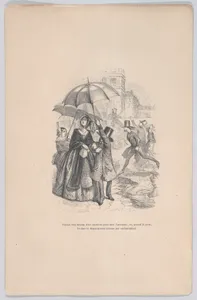
Grandville’s legacy endures as a pioneering figure in caricature and proto-surrealism; his imaginative transformations of the human form influenced later artists from John Tenniel and Gustave Doré to the Surrealists, who admired his subversive wit. Though his personal life was marked by tragedy—he lost his first wife and three sons before remarrying—he left a prolific body of work that continues to delight and provoke viewers with its blend of humor, fantasy, and social critique. One work by the artist is held in the museum’s collection.