Ctrl K
Suzi, known by the pen name meaning "the burning one," was a late-fifteenth-century artist active in the Ottoman Empire, probably in Istanbul or Amasya. Almost nothing is recorded of his early life, training, or personal circumstances beyond a single signed colophon. In 1498–99 he produced an entire illustrated manuscript of the Persian poet Hatifi’s *Khusrau and Shirin*, executing the nastaʿliq calligraphy, illumination, gilding, and seven paintings himself. He described himself in the colophon as “the destitute one” and “the helpless one,” whose heart was “broken into a hundred pieces.”
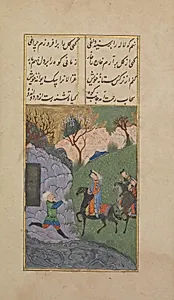
The manuscript’s paintings display a distinctive hybrid style rooted in the western Iranian tradition of the Aq Qoyunlu court yet incorporating European elements such as spatial recession and figural modeling. Scenes such as Khusrau hunting on his horse Shabdiz combine Persianate landscape conventions with a new naturalism that reflects the cosmopolitan artistic exchanges of the early Ottoman period. Hatifi (Abdullah Hatefi, c. 1454–1521), the Iranian poet whose text Suzi copied, was the nephew of the great Timurid poet Jami and spent his life in Khorasan; his *Khamsa* nevertheless enjoyed wide popularity in Ottoman lands, making this copy an early witness to Persian literary culture at the Ottoman court.
Suzi’s decision to undertake every stage of production himself was unusual in an era of specialized workshops. The resulting volume, now in the Metropolitan Museum of Art, remains his only known work. Its rarity and the artist’s self-identification have made it a key document for understanding the beginnings of Ottoman illustrated-book production, when Persian models were being adapted to a new imperial context. Although Suzi left no further trace, the manuscript stands as a unique testament to a versatile, if solitary, talent working at the intersection of Iranian and Ottoman artistic traditions.