Ctrl K
**William Hogarth** (10 November 1697 – 26 October 1764) was an English painter, engraver, satirist, and writer whose innovative “modern moral subjects” transformed visual storytelling in 18th-century Britain.
Born in London to a struggling Latin schoolmaster, Hogarth began his training as an apprentice to the engraver Ellis Gamble before pursuing formal study. In 1720 he enrolled at the St Martin’s Lane Academy run by Louis Chéron and John Vanderbank, and in 1724 he joined the drawing school established by Sir James Thornhill, serjeant-painter to the king. Hogarth later married Thornhill’s daughter Jane in 1729, cementing a personal and professional link to one of Britain’s leading decorative painters.
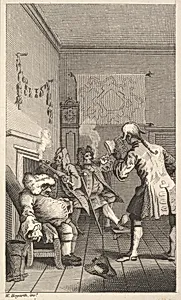
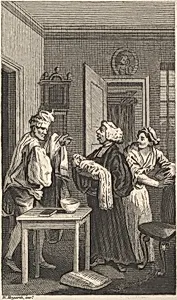
Hogarth developed a distinctive satirical style that blended realistic portraiture with sequential narrative, often exposing the follies of contemporary society. His breakthrough came with the six-scene series *A Harlot’s Progress* (1731), followed by the eight-plate *A Rake’s Progress* (1733–35) and the six-canvas *Marriage A-la-Mode* (1743–45). Later works such as *Industry and Idleness* (1747) and the contrasting prints *Beer Street* and *Gin Lane* (1751) reinforced his reputation as a moral commentator. He also supplied the frontispiece for Laurence Sterne’s novel *Tristram Shandy*, linking his visual wit to one of the era’s most experimental literary voices.
Hogarth’s legacy rests on both his artistic innovations and his advocacy for artists’ rights. His lobbying produced the Engravers’ Copyright Act of 1735 (“Hogarth’s Act”), the first law to protect visual works. Widely reproduced in his lifetime, his prints shaped public taste and influenced generations of caricaturists and social commentators, establishing him as the most significant English-born artist of his generation.