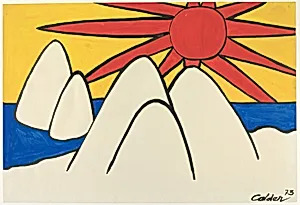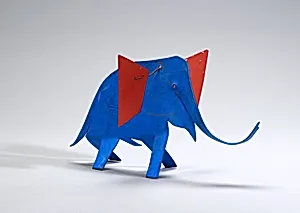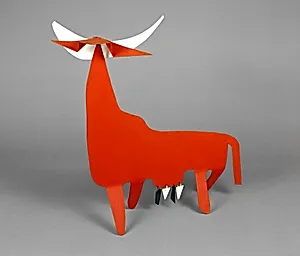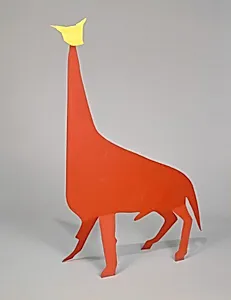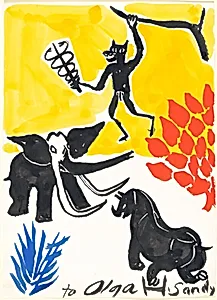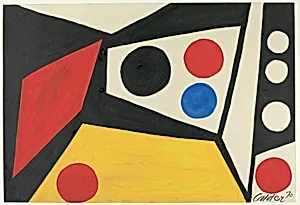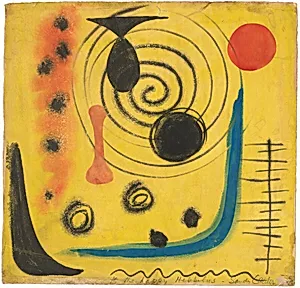
Alexander Calder was born on July 22, 1898, in Lawnton, Pennsylvania, into a family of sculptors spanning three generations: his grandfather Alexander Milne Calder created the colossal bronze William Penn atop Philadelphia City Hall, and his father Alexander Stirling Calder was a celebrated monumental sculptor. Despite this lineage, Calder first pursued mechanical engineering at Stevens Institute of Technology, graduating in 1919. He eventually followed his inherited instinct toward art, enrolling at the Art Students League in New York, where he studied under George Luks, Boardman Robinson, and John Sloan.
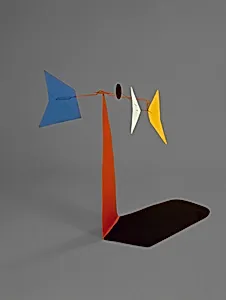
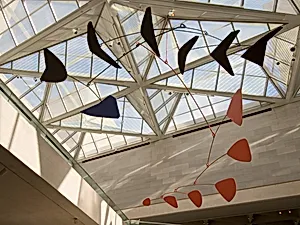
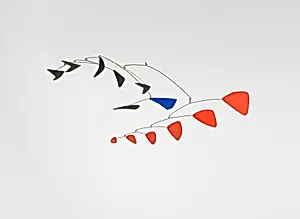
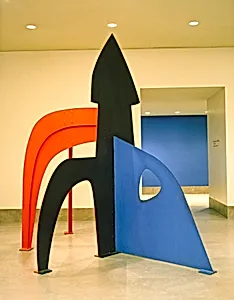
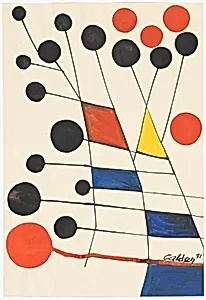
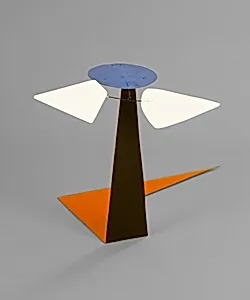
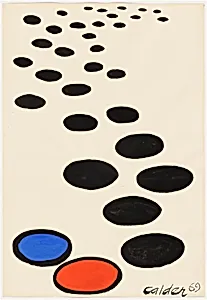
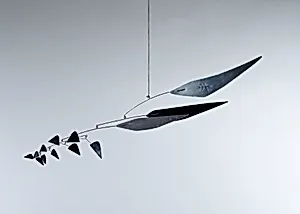
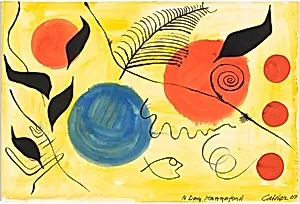
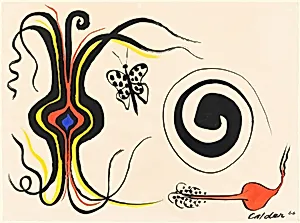
Moving to Paris in 1926, Calder entered the vibrant circle of European modernism and became friends with Joan Miró, Fernand Léger, and Marcel Duchamp. He also created his celebrated Cirque Calder, a miniature circus of wire and found materials that he performed for delighted audiences including Duchamp and Miró. A visit to Piet Mondrian's studio in 1930 — with its grids of pure color — was, by Calder's own account, a revelation that propelled him decisively into abstraction. He began making abstract wire constructions and then motorized sculptures, which Marcel Duchamp christened "mobiles" in 1931 — a French word carrying the double meaning of motion and motive. By 1932, Calder had abandoned motors in favor of air currents alone, allowing chance and environment to animate his hanging wire-and-metal compositions. Jean Arp coined the complementary term "stabiles" for Calder's grounded, non-moving structures.
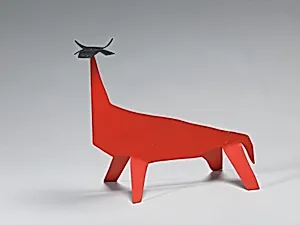
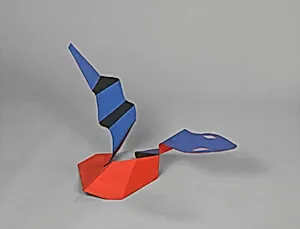
Calder's output was staggering in range and scale, from intimate wire jewelry to monumental public sculptures. Among the most recognized are Lobster Trap and Fish Tail (1939, Museum of Modern Art), La Grande Vitesse (1969, Grand Rapids, Michigan), and Flamingo (1974, Chicago). He was posthumously awarded the Presidential Medal of Freedom in 1977. His legacy — kinetic sculpture as an art form in its own right — has been foundational to modern and contemporary art worldwide.