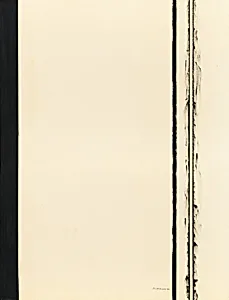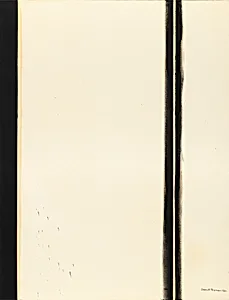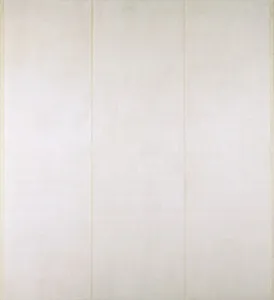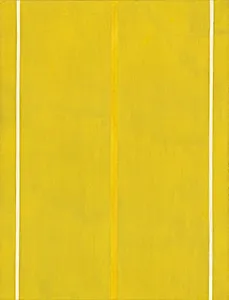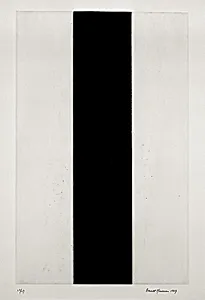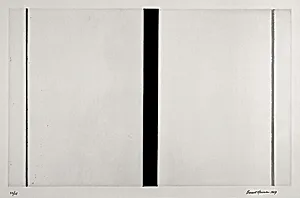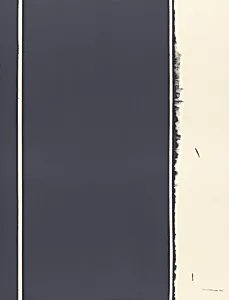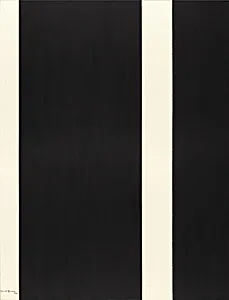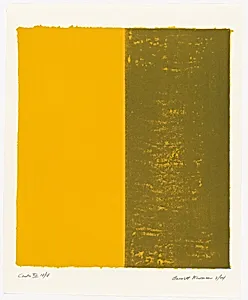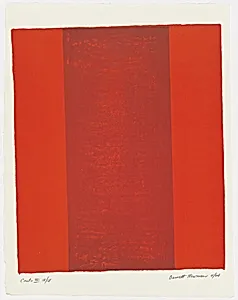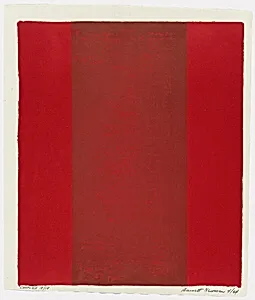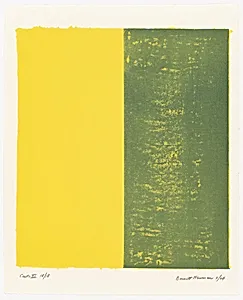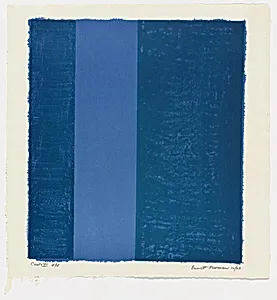
Barnett Newman (1905–1970) was an American artist and a leading figure of Abstract Expressionism and Color Field painting whose radical reductions of pictorial elements to pure color and vertical line — which he called "zips" — fundamentally altered the course of postwar American art. Born in New York City to Jewish immigrants from Poland, he studied at the Art Students League and the City College of New York.
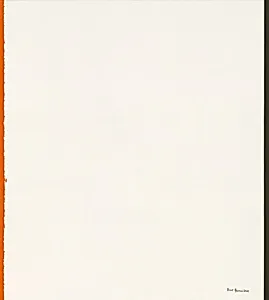
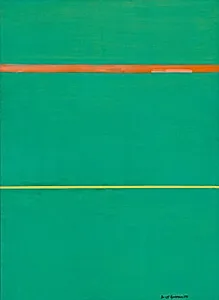
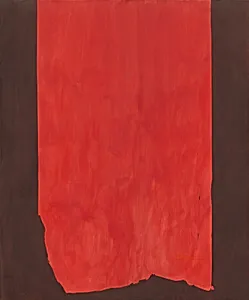
Newman's artistic breakthrough came with "Onement I" (1948), a small painting of a cadmium red field divided by a single vertical stripe of lighter red-orange. This "zip" — a narrow vertical band bisecting a field of color — became his signature motif and the basis for his mature work. Newman saw these paintings not as formal exercises but as expressions of the sublime, exploring themes of creation, transcendence, and the human capacity for awe.
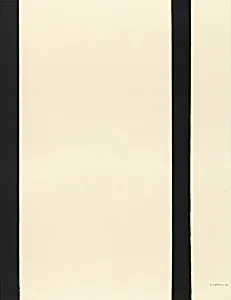
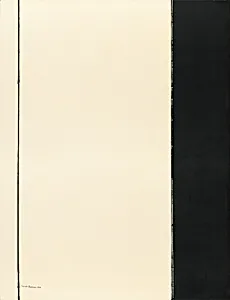
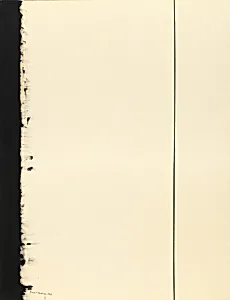
His paintings expanded in scale throughout the 1950s and 1960s, culminating in monumental works like "Vir Heroicus Sublimis" (1950–51), an enormous canvas of saturated red traversed by five thin vertical zips, and the "Stations of the Cross" series (1958–66), fourteen black-and-white paintings that constitute his most sustained meditation on suffering and spiritual crisis. He also produced important sculptures, including "Broken Obelisk" (1963–67), an inverted steel obelisk balanced on a pyramid.
Newman's ideas about the sublime, his insistence on the ethical and spiritual dimensions of abstract art, and his radical reduction of painting to its essential elements were deeply influential on subsequent Color Field painters, Minimalists, and conceptual artists. His work is held by the Museum of Modern Art, the National Gallery of Art, the Tate, and the Stedelijk Museum in Amsterdam.