Ctrl K
1883–1965
Charles Sheeler (1883–1965), born Charles Rettew Sheeler Jr. in Philadelphia, Pennsylvania, began his artistic training at the Pennsylvania Museum School of Industrial Art from 1900 to 1903, where he studied industrial drawing and applied arts. He continued at the Pennsylvania Academy of the Fine Arts from 1903 to 1906, studying under the Impressionist painter William Merritt Chase. Trips to Europe, including Italy and Paris in 1908–1909, exposed him to masters like Giotto, Piero della Francesca, Picasso, and Braque, sparking his interest in Cubism and geometric form. Early on, Sheeler shared a Doylestown farmhouse with friend Morton Livingston Schamberg, whose death in the 1918 influenza epidemic deepened his focus on machinery and vernacular architecture.
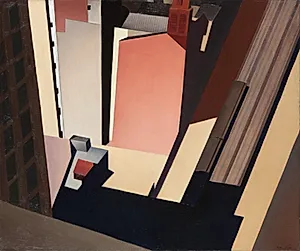
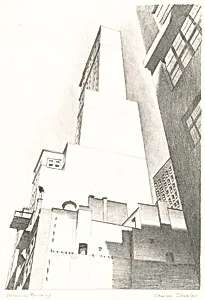
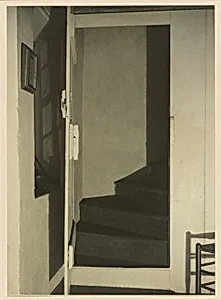
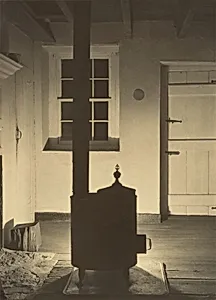
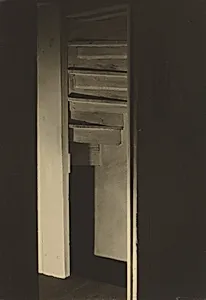
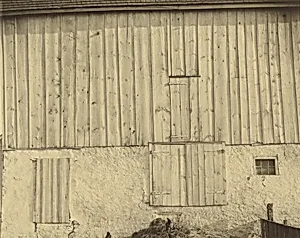
Sheeler pioneered Precisionism, a distinctly American modernist style blending sharp, quasi-photographic realism with abstracted geometry to celebrate industrial and rural subjects. Self-taught in photography with a modest Brownie camera, he blurred lines between mediums, often painting from his photographs. Major works include the photograph *Doylestown House—The Stove* (1917), paintings like *Church Street El* (1920), *Upper Deck* (1928–1929), *American Landscape* (1930) depicting Ford's River Rouge Plant, *Americana* (1931), and *River Rouge Plant* (1933). His 1921 avant-garde film *Manhatta*, co-directed with Paul Strand, poetically captured Manhattan's skyline, earning National Film Registry status. Commissions from Ford and others in the 1920s–1930s elevated factories to cathedrals of modernity, while his "Power" series (1939–1940) for *Fortune* magazine—*Rolling Power*, *Steam Turbine*—exalted machinery's rhythm.
In later years, Sheeler worked as a photographer for the Metropolitan Museum (1942–1945), alongside Edward Weston, and produced abstracted late works like *Golden Gate* (1955) using multi-viewpoint photomontage. Retrospectives at MoMA (1939) and others cemented his legacy as a founder of American modernism, bridging machine-age precision with nostalgic Americana. His oeuvre, spanning over 16 key pieces in major collections, endures for transforming industrial icons into timeless visual symphonies.