Ctrl K
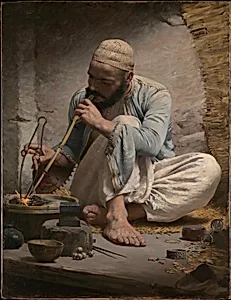
1851–1914
Charles Sprague Pearce, born on October 13, 1851, in Boston, Massachusetts, grew up in a cultured family immersed in art and exotic imports; his father, Shadrach H. Pearce, ran a business dealing in Chinese porcelain, sparking the young artist's fascination with Eastern motifs. After attending the Brimmer School and Boston Latin School, Pearce worked briefly in the family firm before departing for Paris in August 1873. There, he enrolled in the atelier of Léon Bonnat, the esteemed academic painter renowned for his rigorous training in anatomy, modeling, and dramatic lighting, which profoundly shaped Pearce's early technical mastery.
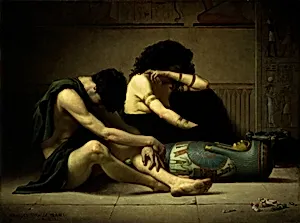
Pearce's career ignited with travels to Egypt in 1873 alongside Frederic Arthur Bridgman to treat his consumption, and to Algeria in 1874, fueling his Orientalist phase. He debuted at the Paris Salon in 1876 with a portrait, followed by ambitious Biblical history paintings: *La Mort du Premier Né* (Death of the First-Born, 1877), *Le Sacrifice d’Abraham* (1879), and *Décollation de Saint Jean-Baptiste* (The Decapitation of St. John the Baptist, 1881), the latter earning an honorable mention. Experimenting boldly, he incorporated Japonisme in *Femme à l’Éventail* and *Fantaisie* (both ca. 1883), securing medals for *Porteuse d’Eau* (Water Carrier, 1883) at the Salon and *Peines de Coeur* (1885) at the Pennsylvania Academy. Working in the academic realist tradition, Pearce blended ethnographic precision with dramatic narratives, evoking Gérôme's influence.
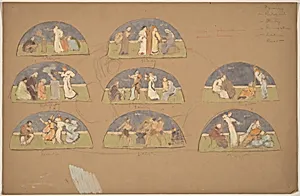
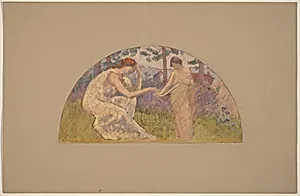
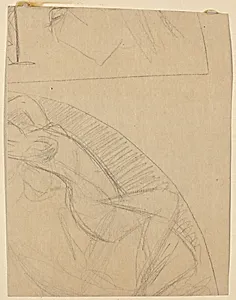
Settling in Auvers-sur-Oise after 1885 with his wife, Louise Catherine Bonjean (Antonia), Pearce shifted to empathetic depictions of French peasants, as in *A Village Funeral in Brittany* (1891) and *The Shawl* (c. 1900), while venturing into plein-air naturalism and symbolism. His grandest commission came in 1896: murals for the Library of Congress's Thomas Jefferson Building—*Religion*, *Labor*, *Recreation*, *Rest*, *Study*, and *Family*—alongside a portrait of sculptor Paul Wayland Bartlett (1890). These works showcased his versatility across oil, drawing, and fresco.
Pearce's legacy endures as a bridge between American expatriates and European academies; a founding vice president of the Paris Society of American Painters, he organized pivotal U.S. exhibitions abroad and received the Chevalier of the Legion of Honor (1894), plus orders from Belgium, Prussia, and Denmark. An Associate National Academician in 1906 (full membership posthumous, 1920), he died on May 18, 1914, in Auvers-sur-Oise, leaving a corpus celebrated for its humanistic depth and technical finesse.
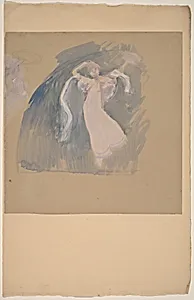
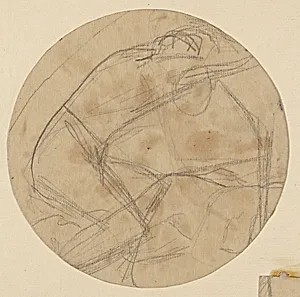
![Study of a Figure from Behind [recto]](https://images.artheonmuseum.org/nga/thumb/study-of-a-figure-from-behind-recto-nga-92073.webp)
![Study of Figures [verso]](https://images.artheonmuseum.org/nga/thumb/study-of-figures-verso-nga-92074.webp)
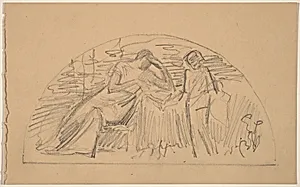
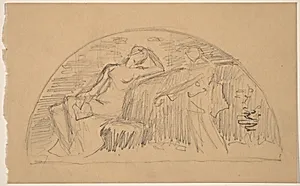
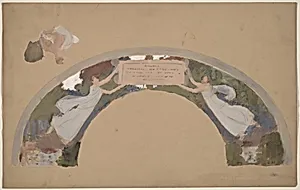
![Study for a Lunette [recto]](https://images.artheonmuseum.org/nga/thumb/study-for-a-lunette-recto-nga-92066.webp)
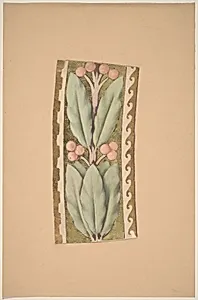
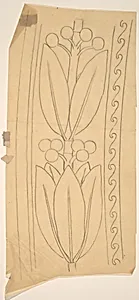
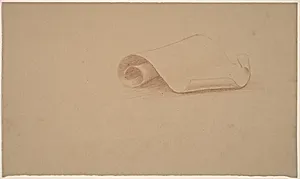
![Study of a Flower [verso]](https://images.artheonmuseum.org/nga/thumb/study-of-a-flower-verso-nga-92067.webp)
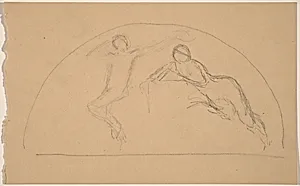
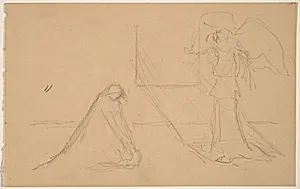
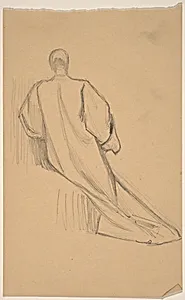
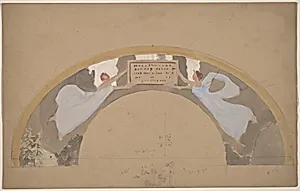
![Studies for a Lunette [recto]](https://images.artheonmuseum.org/nga/thumb/studies-for-a-lunette-recto-nga-92078.webp)
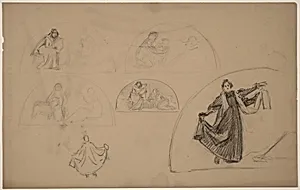
![Studies for a Lunette [verso]](https://images.artheonmuseum.org/nga/thumb/studies-for-a-lunette-verso-nga-92079.webp)