
Ctrl K
1788–1856
Elisha Haydon Collier (1788–1856), born in Boston, Massachusetts, remains a figure whose early life is not well documented, with no records of formal artistic training, teachers, mentors, or affiliation with any art school or movement. As an American engineer and gunsmith, he gained prominence through his innovative designs in firearms during the early 19th century, a period when mechanical ingenuity intersected with the decorative arts of arms and armor. Relocating to London around 1818, Collier patented improvements to an earlier revolving mechanism conceived by Captain Artemas Wheeler of Concord, Massachusetts, transforming it into one of the first practical flintlock revolvers.
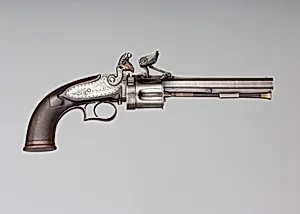
Collier's signature work, the Second Model Five-Shot Flintlock Revolver (ca. 1820), exemplifies his style: handmade with remarkable precision, featuring a hand-rotated cylinder, integrated priming powder magazine, and elegant steel construction accented by walnut, rosewood, silver, and brass. Produced in collaboration with manufacturer John Evans & Son from 1819 to 1824, approximately 225 pistols and long guns were made, including rare revolving shotguns and carbines. This .47-caliber flintlock prioritized accuracy and reload speed via its single barrel and self-priming action—automatically dispensing powder when the hammer cocked—though limited by unreliable flints. Housed today in collections like The Metropolitan Museum of Art's Arms and Armor department, it stands as a pinnacle of early industrial design, blending functionality with aesthetic refinement.
Beyond firearms, Collier's inventive spirit extended to a patented steam boiler for ships (1836) and a nail-making machine (1839), but his revolver legacy endures as a precursor to modern handguns. Its technology and appearance directly anticipated Samuel Colt's percussion revolvers two decades later, influencing the evolution of repeating firearms amid the Industrial Revolution's embrace of technological heroism. Returning to Boston by his death in 1856, Collier's contributions highlight how American ingenuity shaped European arms design, securing his place in the history of functional art objects that bridged utility and elegance.