Ctrl K
1864–1938
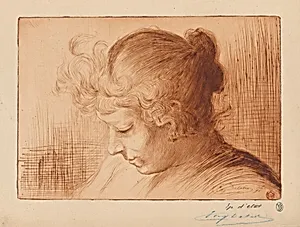
Eugène Delâtre (1864–1938) was a French painter, etcher, and printmaker who became one of the most important innovators of color etching in the late 19th and early 20th centuries. Born into an artistic family as the son of Auguste Delâtre, the most sought-after printer of fine etchings in Paris, Eugène quickly mastered his father's technical expertise while developing his own distinctive artistic vision. During the 1890s, alongside Jean-François Raffaëlli and Manuel Robbe, Delâtre led the revival of color etching, transforming what had been primarily a monochrome medium into a vehicle for sophisticated chromatic effects. His prolific output of approximately 600 plates explored the full range of printmaking techniques—etching, drypoint, aquatint, engraving, lithography, and woodcut—with particular emphasis on color printing, which he pioneered in roughly 200 of his works.
Born on December 10, 1864, in Paris, Eugène Delâtre grew up immersed in the world of fine art printmaking. His father, Auguste Delâtre (1822–1907), had established himself as the preeminent printer of etchings in late 19th-century Paris, working with many of the period's most important artist-etchers.
Young Eugène received training both from his father, who taught him printing and etching techniques, and from the painter John Lewis Brown, who instructed him in drawing and painting. This dual education—combining the technical mastery of printmaking with the artistic sensibility of painting—would prove crucial to his later innovations in color etching.
Eugène quickly absorbed his father's expertise, demonstrating exceptional facility with the complex processes of etching and printing. However, rather than simply continuing his father's work, he developed ambitions to expand the technical and artistic possibilities of the medium.
During the mid-1890s, Delâtre gained international recognition as an innovative etcher, contributing plates to influential publications including L'Estampe Originale in 1894. These early works, many printed in multiple colors, announced his commitment to expanding the chromatic possibilities of printmaking.
Along with Jean-François Raffaëlli and Manuel Robbe, Delâtre pioneered the revival of color etching, a technique that had fallen out of fashion but which these artists transformed into a sophisticated modern medium. Color etching required extraordinary technical skill: the artist had to plan the color scheme carefully, often using multiple plates or multiple inkings of a single plate, and control the registration and printing with exceptional precision.
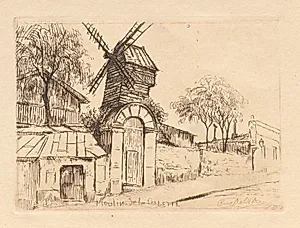
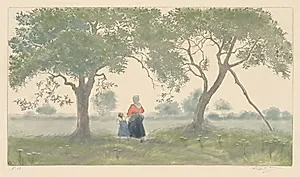
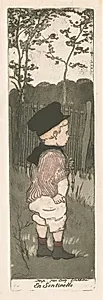
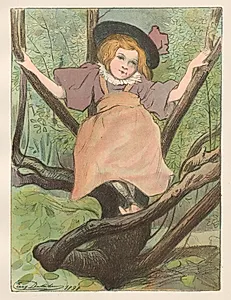
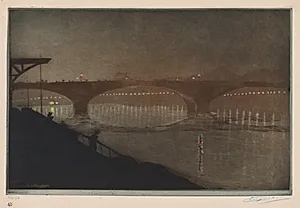
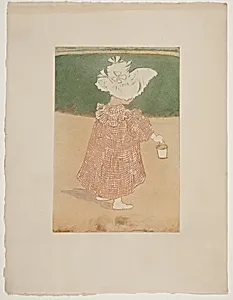
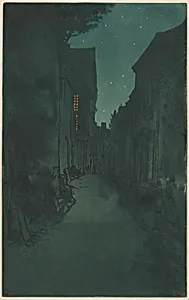
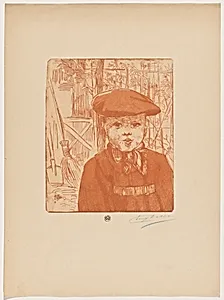
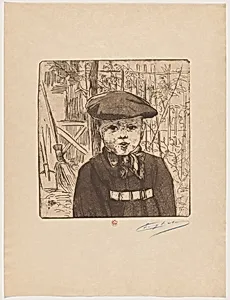
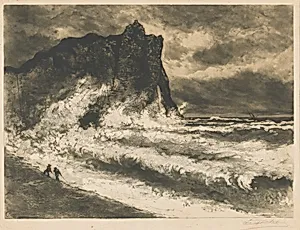
Delâtre's color etchings depicted Parisian street scenes, landscapes, and genre subjects with a distinctive atmospheric quality. His mastery of tone and color relationships created prints of remarkable subtlety and beauty, demonstrating that etchings could achieve chromatic effects rivaling those of paintings.
Throughout his career, Delâtre maintained an extraordinarily productive output, creating an estimated 600 plates over his lifetime. This prolific production reflected both his technical facility and his endless curiosity about printmaking processes.
He explored virtually every printmaking technique: etching, drypoint, aquatint, engraving, lithography, and woodcut. Approximately 200 of his prints incorporated color, making him one of the most important practitioners of color printmaking of his era. His experimental approach involved constantly testing new combinations of techniques, color schemes, and printing methods.
Beyond creating his own work, Delâtre continued his father's tradition of printing for other artists, using his exceptional technical skills to realize other artists' visions. He died on September 24, 1938, in Paris at age seventy-three, leaving a substantial body of work held in major collections including the National Gallery of Art in Washington and the Museum of Modern Art in New York.
Artheon Research Team
Last updated: 2025-11-09
Biography length: ~484 words