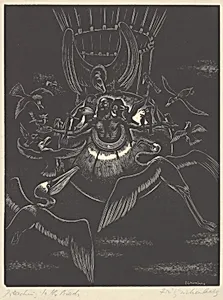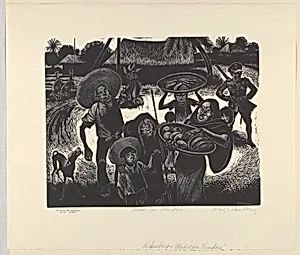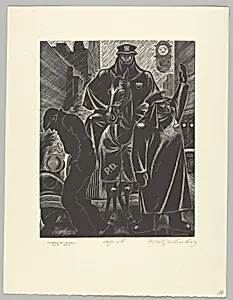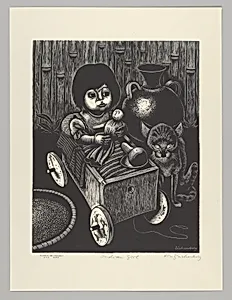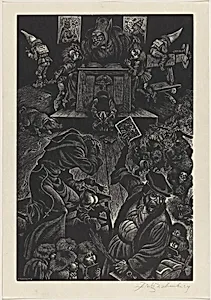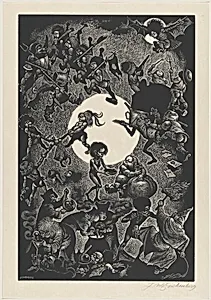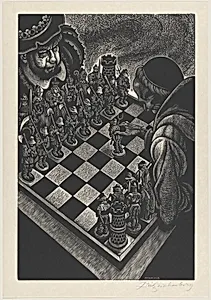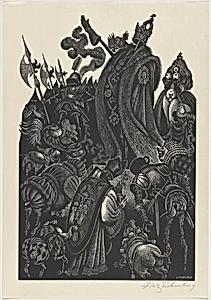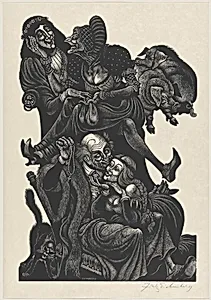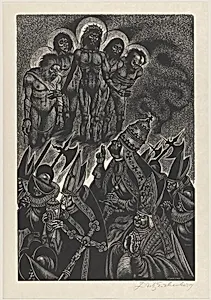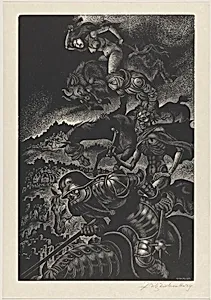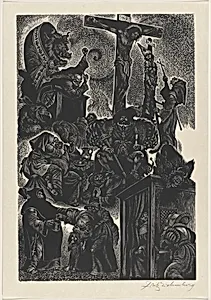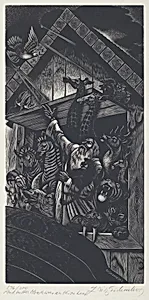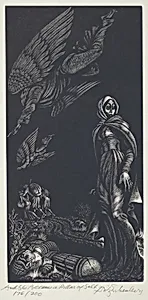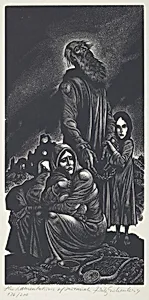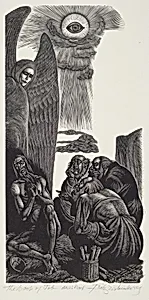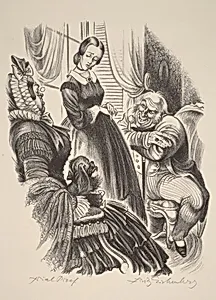
Fritz Eichenberg (1901–1990), born in Cologne, Germany, to a Jewish family, endured the harrowing bombings of World War I as a child, experiences that ignited his lifelong commitment to anti-war themes and social satire. After apprenticing as a printer and studying at the Municipal School of Applied Arts in Cologne, he honed his craft at the Academy of Graphic Arts in Leipzig under the mentorship of Professor Hugo Steiner-Prag, a pivotal figure in European book illustration who inspired Eichenberg's path in wood engraving and caricature. Launching his career in Berlin in 1923, he illustrated for magazines like *UHU* with biting political caricatures, but the rise of Nazism forced his emigration to New York City in 1933 with his wife and children.
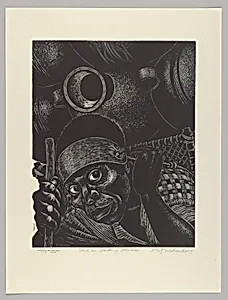
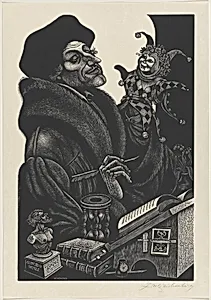
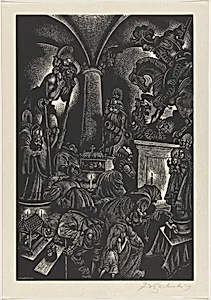
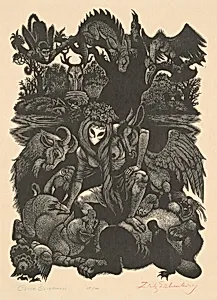
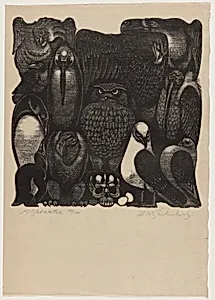
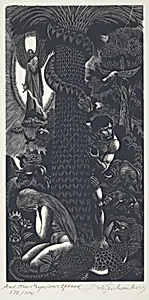
In America, Eichenberg mastered intricate white-line wood engravings, blending social realism with psychological depth to capture spiritual turmoil, fantasy, and human frailty—qualities that defined his illustrations for literary giants. He brought classics to vivid life, including Fyodor Dostoyevsky's *The Brothers Karamazov*, Leo Tolstoy's *War and Peace* and *Anna Karenina*, Emily Brontë's *Wuthering Heights* (notably his iconic 1943 engraving of Heathcliff under the tree), Edgar Allan Poe, Jonathan Swift, and the Brontë sisters. Other highlights include *Mistress Masham's Repose* (1946) by T.H. White, *The Dream of Reason* (wood engraving evoking Goya), and *The Artist & Seven Deadly Sins*. His prints pierced social divides, entering homes of the poor and elite alike, while contributions to *The Nation* (1930–1980) and the WPA Federal Arts Project amplified his voice on Depression-era struggles and World War II horrors.
Eichenberg's influence extended through teaching at the New School for Social Research, Pratt Institute—where he co-founded the Pratt Graphic Arts Center in 1956—and as head of the University of Rhode Island's art department. Following his wife's death in 1937, he embraced Quakerism in 1940, later befriending Dorothy Day and illustrating for the *Catholic Worker*, merging faith with activism in works like *Art and Faith* (1952). Elected to the National Academy of Design (1947–1949), he authored *The Wood and the Graver* (1977), cementing his legacy as America's preeminent wood engraver, whose empathetic engravings continue to illuminate the human spirit's darkest conflicts and brightest hopes.