
Ctrl K
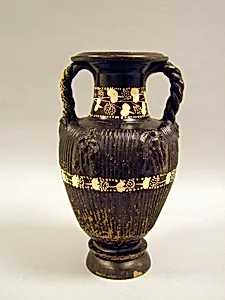
**Group with Horizontal Ivy Leaves** was a workshop or stylistic collective of Hellenistic Greek artisans active in the early Ptolemaic period, roughly 275–250 BCE. Their works are identified today by a distinctive decorative motif of horizontal ivy leaves, a hallmark that distinguishes their output among the many anonymous potters of the era. Operating within the vibrant cultural milieu of Greek settlements in Egypt and the eastern Mediterranean, these craftsmen specialized in terracotta vessels that skillfully imitated more luxurious metal prototypes.
Their artistic practice centered on black-glazed terracotta amphorae and related forms, featuring applied relief decoration, twisted handles, and vertical ribbing. A prime example is the terracotta amphora now in the Metropolitan Museum of Art, which bears relief figures of Herakles on one side of the shoulder and Eros holding a cornucopia on the other, with additional heads below the handles. This vessel was discovered in the Hadra cemetery of Alexandria and is believed to have been produced in a workshop in western Crete before being exported to Ptolemaic Egypt, illustrating the lively trade networks of the Hellenistic world.
Little is known of the individual members of the group or their specific training, as is typical for such collective attributions in classical archaeology. Their style reflects the broader Hellenistic interest in ornate, sculptural surface decoration on functional objects, blending Greek mythological themes with the cosmopolitan tastes of Ptolemaic patrons.
The legacy of the Group with Horizontal Ivy Leaves endures through the survival of their finely crafted vessels in major museum collections. These pieces provide valuable insight into Hellenistic pottery techniques, the dissemination of artistic motifs across the Mediterranean, and the role of Cretan workshops in supplying the elite markets of Alexandria. Their work continues to be studied as a representative example of the refined yet accessible luxury goods that characterized the Ptolemaic era.