Ctrl K

James David Brooks (1906–1992) was born in St. Louis, Missouri, and moved with his family to Dallas, Texas, in 1916, where he graduated from Oak Cliff High School in 1922.) He studied at Southern Methodist University from 1923 to 1925, followed by training at the Dallas Art Institute under James A. Waddell and private lessons with Martha Simkins. In 1926, Brooks relocated to New York City, working as a commercial letterer while attending night classes at the Art Students League under Kimon Nicolaïdes and Boardman Robinson.) During the 1930s, he embraced social realism, creating murals for the Federal Art Project and Treasury Section of Fine Arts, including the surviving *Labor and Leisure* (1938) in Little Falls, New Jersey, and the expansive 235-foot *Flight* (1938–1942) at LaGuardia Airport's Marine Air Terminal, restored in 1980 after being painted over.)
From 1942 to 1945, Brooks served as a combat artist in the Middle East, producing drawings and gouaches from wartime photographs. Returning home, he met and married artist Charlotte Park in 1947 (after a prior marriage to Mary MacDonald in 1938), settling in East Hampton near friends Jackson Pollock and Lee Krasner, whose Greenwich Village apartment he had briefly occupied.) Transitioning to abstraction, Brooks became a first-generation Abstract Expressionist in the New York School tradition, pioneering staining techniques by diluting oil paints on raw canvas to create calligraphic forms and "painterly accidents" revealing personal depths. His first solo exhibition of dripped abstractions, echoing Pollock's influence, opened at Peridot Gallery in 1950; he participated in the landmark 9th Street Show in 1951.)
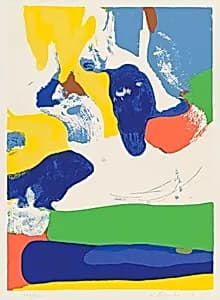
Brooks taught extensively—at Columbia University (1947–1948), Pratt Institute (1948–1955), Yale (1955–1960), and others—shaping generations while producing vibrant works like *Boon* (1957, Tate), *Qualm* (1954, MoMA), *Rasalus* (1959), and *Banter* (1970, Whitney).) Winner of the Logan Medal, his paintings grace collections at MoMA, Whitney, Smithsonian, and Tate. He died of Alzheimer's in 1992; his Springs studio, damaged by Hurricane Carol in 1954 but relocated, was preserved by East Hampton in 2017, safeguarding his legacy as a bridge from muralism to gestural abstraction.)