Ctrl K
1858–1928
Johannes Theodorus 'Jan' Toorop (1858–1928) was one of the most influential Dutch artists at the turn of the twentieth century, whose distinctive Symbolist style and flowing Art Nouveau lines left an indelible mark on European art. Born on December 20, 1858, in Purworejo on the island of Java in the Dutch East Indies (present-day Indonesia), Toorop brought a unique synthesis of Eastern and Western influences to his work that would eventually inspire artists including Gustav Klimt. Toorop's artistic journey encompassed multiple movements—Pointillism, Symbolism, and Art Nouveau—yet he managed to forge a highly personal style characterized by dynamic, unpredictable linework based on Javanese motifs, highly stylized willowy figures, and dreamlike compositions. His conversion to Catholicism in 1905 marked a significant shift in his work toward religious subjects, though his distinctive linear vocabulary remained constant.
Born on December 20, 1858, in Purworejo, Java, in the Dutch East Indies, Toorop spent his formative years immersed in the visual culture of Indonesia, which would profoundly influence his artistic vocabulary throughout his career.
In 1869, at age eleven, he left Indonesia for the Netherlands, where he studied in Delft and Amsterdam. In 1880, he enrolled as a student at the Rijksakademie in Amsterdam, receiving formal academic training.
From 1882 to 1886, Toorop lived in Brussels, joining the artist association L'Essor, which had as its original aim to rebel against conservative art institutions in Brussels. He later joined Les XX (Les Vingts), a progressive group of artists centered on James Ensor, placing him at the forefront of avant-garde artistic developments.
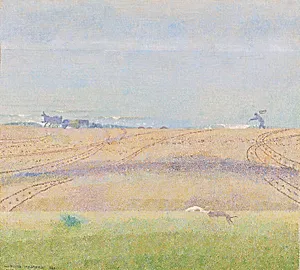
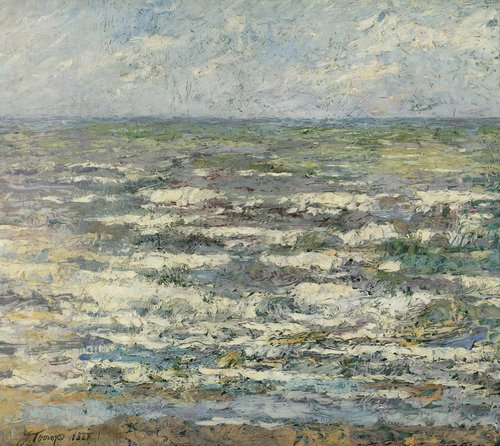
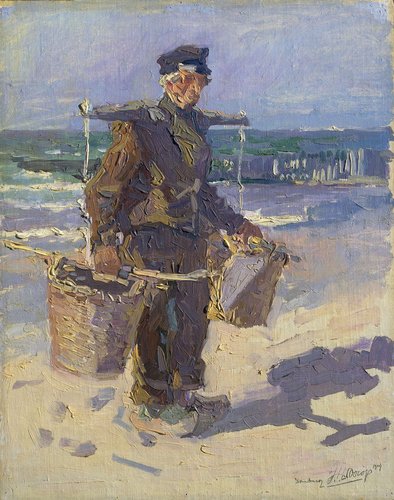
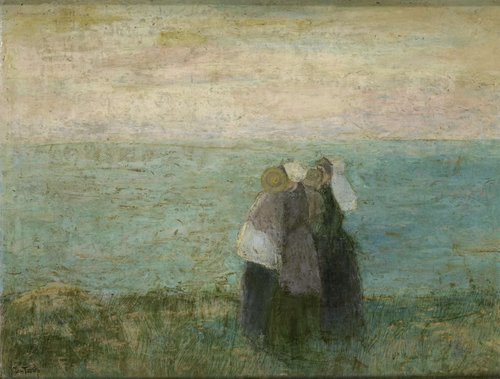
After his marriage to Annie Hall, a British woman, in 1886, Toorop alternated his time between The Hague, England, and Brussels. After 1890, he also frequented the Dutch seaside town of Katwijk aan Zee, where the North Sea landscape provided inspiration.
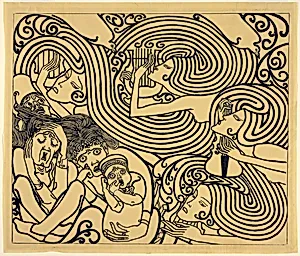
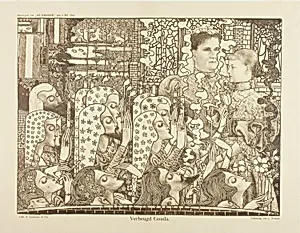
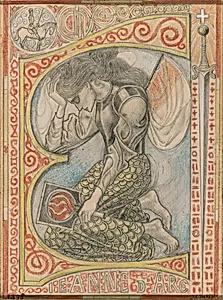
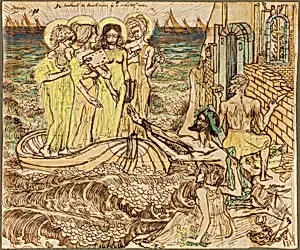
During the early 1890s, Toorop developed his unique Symbolist style, creating large drawings filled with figures and personal symbols. He drew heavily on his Javanese background, incorporating curvilinear designs and mystical imagery that marked his major breakthrough.
His linear and symbolic works from the 1890s, including masterpieces like 'The Three Brides' (1893) and 'Fatalism,' featured his characteristic flowing lines that Gustav Klimt particularly admired—a style sometimes called the 'salad oil style' for its fluid, sinuous quality.
Toorop was one of the few Dutch artists to exhibit twice at the Vienna Secession around the turn of the century, where his work had a profound influence on Klimt and other Viennese artists.
In 1905, Toorop converted to Catholicism, a spiritual transformation that redirected his artistic focus toward religious subjects. His mystical tendencies found new expression in Catholic iconography, though his distinctive linear style persisted.
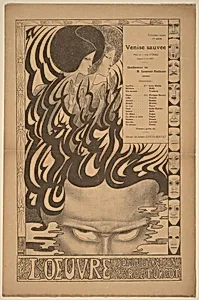
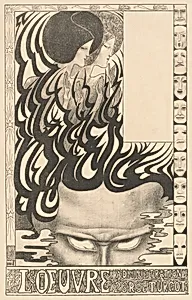
Throughout his later years, Toorop continued to work in multiple media, creating book illustrations, posters, and stained glass designs that demonstrated the versatility of his Art Nouveau aesthetic.
Jan Toorop died on March 3, 1928, in The Hague, leaving behind an extensive oeuvre encompassing drawing, painting, printmaking, and decorative arts that had helped define the visual language of Symbolism and Art Nouveau in the Netherlands.
Artheon Research Team
Last updated: 2025-11-09
Biography length: ~487 words
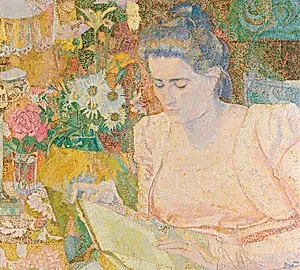
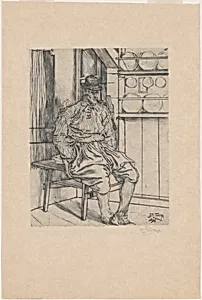
![Charley voor Het Raam [Charley in Front of the Window]](https://images.artheonmuseum.org/nga/thumb/charley-voor-het-raam-charley-in-front-of-the-nga-223451.webp)