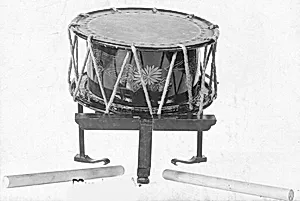
Nambuya Keikichi was a Japanese craftsman active in the 19th century, based in the bustling district of Asakusa, Kamejima-cho, Tokyo. Little is known about his early life or training, as historical records on individual instrument makers from this period are sparse. Asakusa, a vibrant entertainment hub during the late Edo and early Meiji eras, was home to many artisans specializing in traditional crafts, and Keikichi operated within this dynamic urban environment, contributing to Japan's rich tradition of musical instrument production.
Keikichi is renowned for his craftsmanship in creating taiko drums, a quintessential Japanese membranophone characterized by its double-headed, cylindrical form. His surviving work, a meticulously constructed taiko made of wood, hide, and metal, exemplifies the precision of 19th-century Japanese lacquerwork and assembly techniques. Measuring 15.5 cm in length, with a widest diameter of 25.3 cm and head diameters of 35 cm, the drum reflects the functional elegance required for both ceremonial and performative use in festivals, theater, and religious rituals. This piece stands as a testament to the artisan's skill in balancing acoustic resonance with aesthetic harmony, hallmarks of the taiko-making tradition.
Though no other works by Keikichi have been widely documented, his taiko endures as a cultural artifact, acquired in 1889 as part of the Crosby Brown Collection of Musical Instruments and now housed in the Metropolitan Museum of Art's Department of Musical Instruments (object number 89.4.92). This preservation underscores his place in the lineage of Japanese instrument makers whose creations bridged everyday life and artistic expression. Keikichi's legacy, though modestly represented by a single extant example, highlights the unsung contributions of Asakusa's craftsmen to Japan's sonic heritage, inviting modern audiences to appreciate the drum's rhythmic power in museum settings and contemporary performances alike.
