
Ctrl K
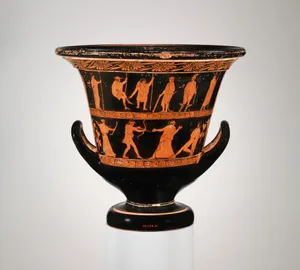
**The Nekyia Painter** was an anonymous Attic vase painter active in Athens during the Classical period, roughly 450–440 BCE. Like many Greek ceramic artists of his era, he is known today only by the conventional name assigned by modern scholars, derived from a major work depicting the Nekyia—the underworld journey of Odysseus from Homer’s *Odyssey*. Working exclusively in the red-figure technique, he produced finely detailed vessels that blended narrative ambition with elegant draftsmanship characteristic of mid-fifth-century Athenian pottery.
His most celebrated surviving work is a large terracotta calyx-krater now in the Metropolitan Museum of Art. Dated circa 450–440 BCE, the vase is divided into two registers. The upper zone shows Herakles, guided by Hermes, encountering Theseus and Peirithoos in Hades, with the god Hades himself visible behind them; surrounding figures include other heroes whose names are inscribed. The lower register depicts further mythological punishments, including Apollo and Tityos on one side and Zeus battling a giant on the other. The composition demonstrates the painter’s skill in arranging complex multi-figure scenes across the curving surface of the krater while maintaining clarity and dramatic tension.
No records survive of the Nekyia Painter’s training, workshop, or personal life. He belonged to the vibrant community of Attic red-figure specialists whose output supplied both domestic symposia and export markets across the Mediterranean. His style aligns with the broader Classical interest in mythological narrative and human emotion, continuing the tradition established by earlier masters while reflecting the refined proportions and balanced compositions favored in the decades after the Persian Wars.
Although only a handful of vases have been attributed to him or his immediate circle, the Nekyia Painter’s work remains valuable for its vivid illustration of epic and underworld themes. His calyx-krater stands as a key monument of Classical vase painting, offering modern viewers direct insight into how Athenians visualized the heroic past and the mysteries of the afterlife.
All 1 artworks loaded