
Ctrl K
1667–1744
Albrecht Schmid, a prominent figure in the Baroque printmaking scene of southern Germany, was born in 1667 in Ulm and spent much of his career in Augsburg, where he died in 1744. Working as a "Briefmaler"—a specialist in popular broadsheet prints—and form cutter affiliated with the woodcutters' guild, Schmid established himself as a prolific publisher and producer of affordable devotional imagery, playing cards, and moralistic scenes. His workshop in Augsburg churned out hand-colored woodcuts and copper engravings that catered to a broad audience, from pious households to collectors of cut-out sheets (Ausschnittbogen) intended for coloring and assembly into personal albums.
Little is known about Schmid's early training, as his formative years remain sparsely documented; no specific teachers or art schools are recorded in surviving sources. He operated firmly within the robust Augsburg tradition of graphic arts, embracing a lively Baroque style characterized by dramatic compositions, rich contrasts, and theatrical religious narratives suited to woodcut and engraving techniques. Often heightening his prints with watercolor or metallic accents, Schmid's works blended folk art accessibility with sophisticated publisher savvy, reprinting earlier designs while innovating series for popular consumption.
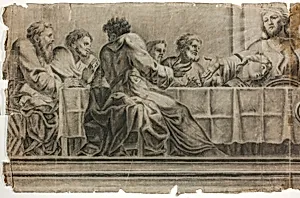
Among his notable creations are the poignant *Last Supper*, a German drawing in black chalk and charcoal heightened with white on laid paper, now in the Art Institute of Chicago; a hand-colored woodcut depicting characters from the Adam and Eve story at the Victoria & Albert Museum; and devotional prints like *The Pious Housemaid*, *The Blessed Virgin Mary of Einsiedeln*, and series on the Seven Deadly Sins. Other inventories list his engravings of Katharina von Bora and the glorification of the Virgin Mary, alongside equestrian scenes such as *Riding School*.
Schmid's legacy endures as a bridge between elite art and everyday devotion, disseminating Baroque imagery across Europe and even influencing Meissen porcelain designs through his engravings. His prints, prized today in collections like those of the Harry Ransom Center and Liechtenstein princely holdings, highlight Augsburg's role as a printing powerhouse, preserving vibrant snapshots of 18th-century popular piety and morality for modern audiences.