Ronald Davis (born 1937) is an American abstract painter associated with the hard-edge and lyrical abstraction movements that flourished on the West Coast of the United States during the 1960s and 1970s. Coming of age artistically in California, Davis was part of a generation of artists who developed a distinctive alternative to the dominant New York scene, embracing formal experimentation and a cool, geometric sensibility that nonetheless retained expressive energy.
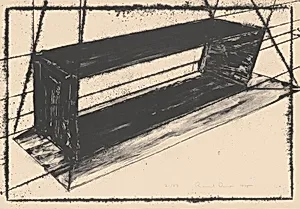
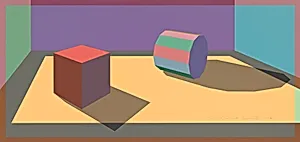
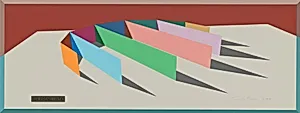
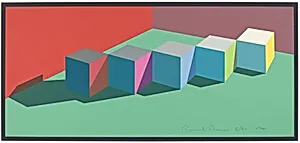
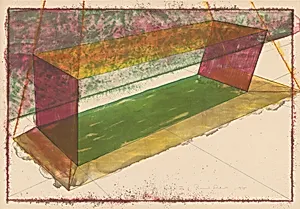
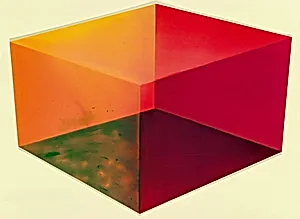
Davis became particularly well known for his shaped canvases and his innovative use of polyester resin, a material that allowed him to create paintings with a glassy, luminous surface unlike anything achievable with conventional paint on canvas. These works often played with perspectival illusion, depicting three-dimensional geometric forms — open boxes, slabs, and planes — in ways that confused and delighted the eye. The relationship between the depicted form and the physical shape of the canvas became a central concern of his practice, aligning him with contemporaries such as Frank Stella in questioning the conventions of the rectangular picture plane.
His work gained significant critical attention in the late 1960s, with major exhibitions and acquisitions by prominent museums. Davis engaged seriously with the discourse around Minimalism and formalist criticism, and his paintings were discussed by leading critics of the era as important contributions to the ongoing evolution of abstract painting.
In later decades Davis embraced digital technology as a tool for developing compositions, becoming an early adopter of computer-aided design in fine art. This evolution demonstrated his continued commitment to exploring the formal possibilities of abstraction through whatever means were available. His career spans more than six decades, and his work remains a significant chapter in the story of American abstract art.

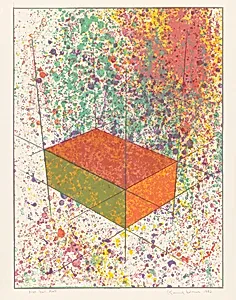
![Drypoint Lambda [special proof]](https://images.artheonmuseum.org/nga/thumb/drypoint-lambda-special-proof-nga-60521.webp)
![Drypoint Zeta [special proof]](https://images.artheonmuseum.org/nga/thumb/drypoint-zeta-special-proof-nga-60372.webp)
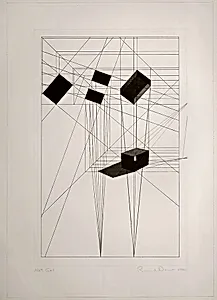
![Drypoint Eta [special proof]](https://images.artheonmuseum.org/nga/thumb/drypoint-eta-special-proof-nga-60515.webp)
![Drypoint Theta [special proof]](https://images.artheonmuseum.org/nga/thumb/drypoint-theta-special-proof-nga-60373.webp)
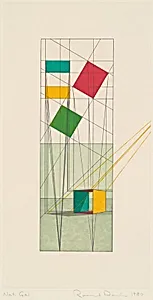
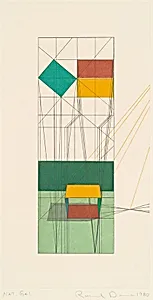
![Drypoint Beta [special proof]](https://images.artheonmuseum.org/nga/thumb/drypoint-beta-special-proof-nga-60516.webp)
![Drypoint Gamma [special proof]](https://images.artheonmuseum.org/nga/thumb/drypoint-gamma-special-proof-nga-60517.webp)
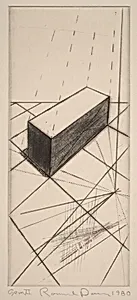
![Drypoint Epsilon [special proof]](https://images.artheonmuseum.org/nga/thumb/drypoint-epsilon-special-proof-nga-60518.webp)
![Drypoint Iota [special proof]](https://images.artheonmuseum.org/nga/thumb/drypoint-iota-special-proof-nga-60523.webp)
![Drypoint Kappa [special proof]](https://images.artheonmuseum.org/nga/thumb/drypoint-kappa-special-proof-nga-60524.webp)
![Drypoint Nu [special proof]](https://images.artheonmuseum.org/nga/thumb/drypoint-nu-special-proof-nga-60525.webp)
![Drypoint Delta [special proof]](https://images.artheonmuseum.org/nga/thumb/drypoint-delta-special-proof-nga-60519.webp)
![Drypoint Mu [special proof]](https://images.artheonmuseum.org/nga/thumb/drypoint-mu-special-proof-nga-60520.webp)