Ctrl K
1847–1926
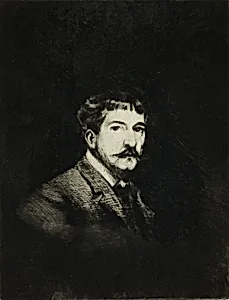
Theodore Casimir Roussel was born on 23 March 1847 in Lorient, Brittany, France, into a naval family. After serving in the Franco-Prussian War, he began painting in 1872 as an entirely self-taught artist, initially rendering scenes of daily life in the meticulous style of the Old Masters. In 1878, he settled permanently in London, where he immersed himself in the vibrant British art scene. There, he married widow Frances Amelia Smithson Bull in 1880—a distant relative of the Smithsonian founder James Smithson—before later wedding Ethel Melville, widow of painter Arthur Melville, following Frances's death in 1909. Roussel's personal life intertwined deeply with his art; his mistress, model Hetty Pettigrew, posed for his breakout work and bore him a child, while her sisters modeled for luminaries like James McNeill Whistler, William Holman Hunt, and John Everett Millais.
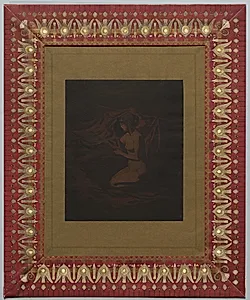
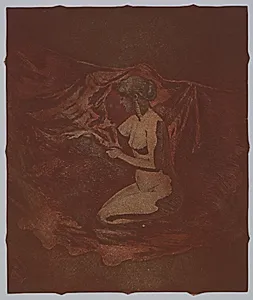
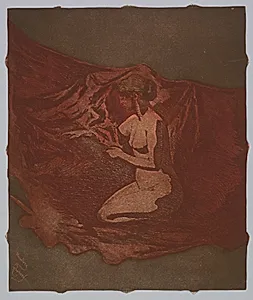
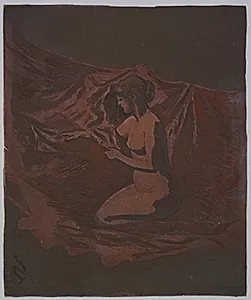
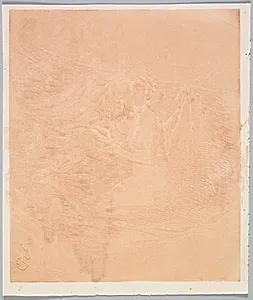
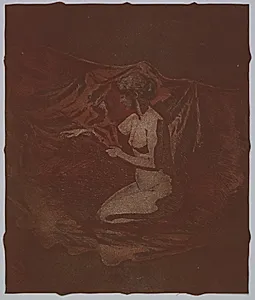
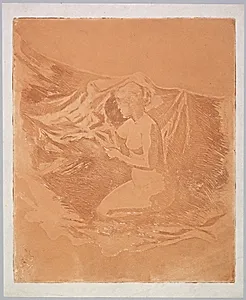
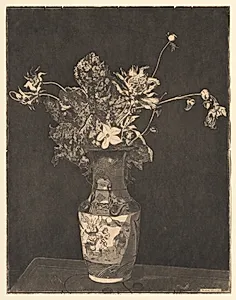
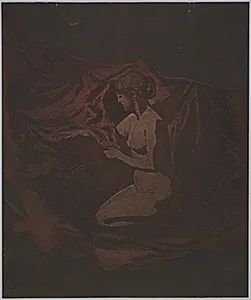
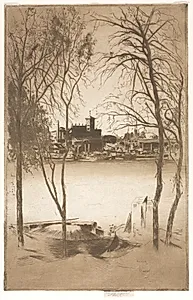
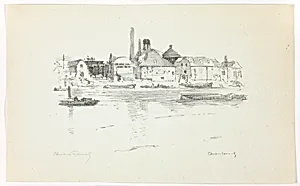
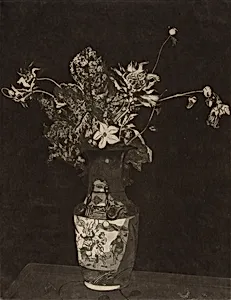
A pivotal encounter came in 1885 when Roussel met Whistler, who became his lifelong friend and mentor, introducing him to etching and drypoint techniques. This influence propelled Roussel's debut at the New English Art Club (NEAC) in 1887, where his life-size nude *The Reading Girl* (1886), featuring Hetty Pettigrew reclining with a book amid lush surroundings, caused a sensation for its bold naturalism and subtle tonal harmonies, echoing Whistler's aesthetic while nodding to Impressionist light effects. Settling in Parsons Green, Roussel shifted to atmospheric Thames landscapes, capturing misty urban vistas in oils and watercolors. He pioneered color etching in England, innovating multi-plate techniques for luminous prints like *Penelope, A Doorway, Chelsea* (1888–89), *The Agony of Flowers* (c. 1890–95), *Sign of the ‘White Horse’, Parson's Green* (c. 1893–4), and *Ships at Fowey* (1911).
Roussel exhibited widely with the NEAC, Royal Society of British Artists (under Whistler's presidency), Royal Scottish Academy, and as a founding member of the Allied Artists' Association in 1908. His eclectic style blended Old Master precision with modern, Whistlerian subtlety and experimental color science, aligning him with British Impressionism's urban lyricism. Though overshadowed by contemporaries, Roussel's legacy endures in his groundbreaking printmaking, which advanced color reproduction, and in monographs like Frank Rutter's 1926 tribute. He died on 23 April 1926 in Hastings, leaving a collection of over 149 known artworks that evoke the poetic haze of fin-de-siècle London.