Ctrl K
1287–1359
Wang Mian (1287–1359), courtesy name Yuanzhang and known by pseudonyms such as Zhushi Shannong ("Mountain Farmer who Cooks Rocks"), was born into a peasant family in Zhuji, Zhejiang province, during the Yuan dynasty. Ambitious to rise above his humble origins, he prepared rigorously for the imperial examinations but failed to earn the coveted jinshi degree. He then pursued studies in ancient military arts and philosophy, drafting battle plans and political treatises, yet these efforts also proved fruitless. Rejecting multiple offers of government service under Mongol rule—symbolizing his disdain for the "barbarian" regime—he briefly worked as a teacher before embracing a reclusive scholar's life, traveling to cities like Nanjing and Suzhou as a freelance artist.
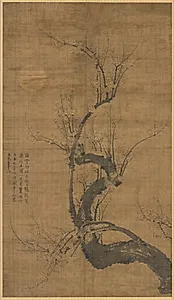
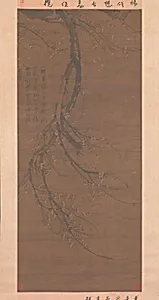
Specializing in the ink-plum (momei) tradition, Wang Mian elevated plum blossom painting to new heights with his bold, vigorous style, blending delicate descriptive techniques from academic predecessors with the expressive, calligraphic brushwork of literati contemporaries. He pioneered the "reverse-saturation" method, rendering blossoms with fine ink washes against stark branches, and innovated by inscribing his own poetry directly onto the paintings—a practice that integrated word and image seamlessly. The plum, blooming defiantly amid winter desolation, embodied purity, endurance, and subtle resistance to foreign rule, resonating deeply in Yuan literati culture. Wang also depicted bamboo, as in Twin Purities of Plum and Bamboo, and was renowned as a poet, calligrapher, and seal carver.
Among his surviving masterpieces are Fragrant Snow at Broken Bridge (14th century), a hanging scroll capturing plum blossoms against a snowy Hangzhou landmark, and A Prunus in the Moonlight (1300s), evoking nocturnal serenity on silk. Other key works include Plum Blossoms in Early Spring, Blossoming Plum, and various Ink Plum compositions, often housed in institutions like the Metropolitan Museum, Cleveland Museum of Art, and Shanghai Museum.
In his later years, Wang served briefly as a military advisor to Zhu Yuanzhang's anti-Mongol forces—future Ming founder—though his Shaoxing campaign failed. Retiring to the Kuaiji Mountains, he planted a thousand plum trees at his "Plum Blossom Retreat," living as an eccentric in ragged clothes and penning an autobiography, Mr. Plum Blossom's Autobiography. His legacy endures as the preeminent Yuan plum painter, profoundly shaping Ming and Qing ink-plum traditions and inspiring literary depictions, such as his romanticized role in Wu Jingzi's 18th-century novel The Scholars. Wang Mian's art remains a poignant emblem of scholarly integrity amid adversity.
All 2 artworks loaded