Ctrl K
1899–1985
Werner Drewes (1899–1985), born in the village of Canig, Germany, to Lutheran pastor Georg Drewes, demonstrated early artistic talent at Saldria Gymnasium, excelling in painting and woodblock printing. Drafted into the German army at eighteen, he served on the Western Front during World War I, finding solace in sketching amid the horrors of war. Postwar, Drewes pursued architecture at the Technische Hochschule in Stuttgart and Berlin before shifting to applied arts at Stuttgart's Kunstgewerbeschule. He studied at the Bauhaus in Weimar from 1921 to 1923 under Johannes Itten, Lyonel Feininger, and Paul Klee, producing his "Ecce Homo" woodblock portfolio, then returned to the Dessau Bauhaus from 1927 to 1930 under László Moholy-Nagy, Wassily Kandinsky—who became a lifelong mentor—and Feininger again. Extensive travels to Italy, Spain, the Americas, and Asia exposed him to old masters like El Greco, enriching his fusion of European modernism and abstraction. Fleeing rising Nazism, he immigrated to New York in 1930 with wife Margarete Schrobsdorff—a weaver—and later their sons Harald, Wolfram, and Bernard; he became a U.S. citizen in 1936.
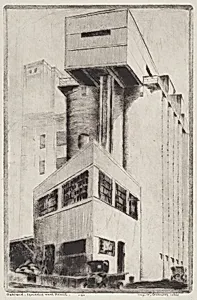
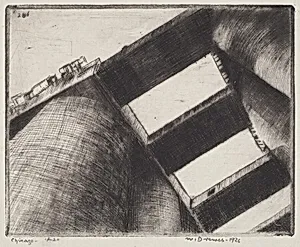
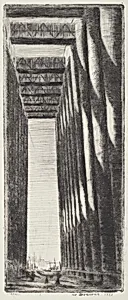
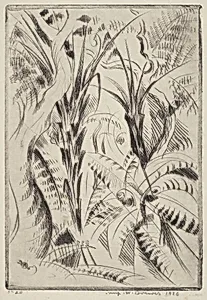
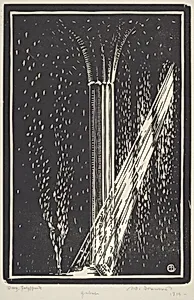
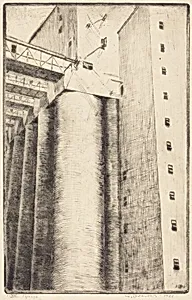
In America, Drewes worked in the Bauhaus school tradition, pioneering abstraction through dynamic prints and paintings that blended nonobjective forms with emotional expressionism, often drawing from nature's rhythms. A prolific printmaker, he created 732 works, including 418 woodcuts like the 1934 series *It Can't Happen Here* warning against fascism, and color woodblocks such as *Autumn Gold* (1969). Notable oils include *In the Blue Space* (1938) and *Study: Blue House in the Woods 2* (1950), where thin glazes evoked organic movement on wood-grained panels, echoing Kandinsky's influence. He innovated multiple-plate color woodcuts and, later, arthritis-inspired collages, bridging pure abstraction and figurative motifs.
Drewes taught extensively, directing the WPA's Graphic Arts Project, instructing at Columbia University, Brooklyn College, and the Institute of Design in Chicago before becoming a tenured professor of design at Washington University's School of Fine Arts from 1946 to 1965. A founding member of the American Abstract Artists (1936) and American Artists Congress, he championed avant-garde ideals amid the Great Depression. Retiring to Bucks County, Pennsylvania, then Reston, Virginia—remarried to educator Mary Louise Lischer—he held over eighty solo shows worldwide. His legacy as a founding father of American abstraction endures through retrospectives like the Smithsonian's 1984 printmaking survey, cementing his role in elevating woodcuts and modernist synthesis stateside.