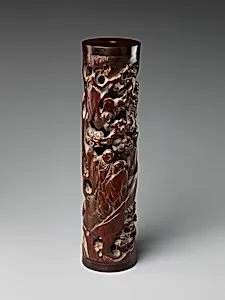
1573–1619
Zhu Sansong (1573–1619) was a master bamboo carver of China's late Ming dynasty, renowned for elevating the art of bamboo engraving to new heights within the Jiading school. Hailing from Jiading in Jiangsu Province (modern-day Shanghai area), he belonged to the celebrated "Three Zhus of Jiading," a three-generation family dynasty that pioneered this craft. As the grandson of Zhu Songlin (also known as Zhu He) and son of Zhu Xiaosong (Zhu Ying), Sansong inherited and perfected a familial legacy of intricate bamboo work, transforming humble bamboo into vessels that rivaled jade or porcelain in elegance.
Little is known of Sansong's early training beyond immersion in his family's workshop, where the knife served as a brush to incise landscapes, figures, and literary scenes with mesmerizing depth. He mastered techniques like high-relief carving (gao diaoke), low relief, openwork, and layered engraving, creating illusions of multi-dimensional space on cylindrical forms such as brush pots and incense holders. His style embodied the literati aesthetic—elegant, scholarly motifs drawn from poetry and drama—hallmarks of the Jiading bamboo carving tradition, which emphasized "knife-as-brush" precision and poetic restraint.
Among his surviving masterpieces are the *Incense Holder with Scholars in a Landscape* (Metropolitan Museum of Art), featuring openwork scholars amid misty peaks to release fragrant incense; a bamboo brush holder depicting a woman reading a letter (National Palace Museum, Taipei); and a brush pot engraved with Chinese cabbage (Palace Museum, Beijing). Other signed works include a pen holder illustrating a maid peeking at a love letter from *Romance of the West Chamber*, blending shallow and deep relief for dramatic effect, and a brushpot with the Seven Sages of the Bamboo Grove.
Sansong's innovations marked the pinnacle of Ming bamboo carving, influencing Qing successors and establishing Jiading as China's bamboo art epicenter. His pieces, prized by collectors for their technical virtuosity and cultural resonance, continue to grace museum collections worldwide, embodying the refined worldview of late imperial scholar-artists. Though his life remains sparsely documented outside his oeuvre, Zhu Sansong's enduring legacy lies in proving that everyday bamboo could house immortal scenes.
All 1 artworks loaded
