
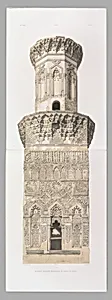
38. Minaret, Mosquée Mohammed el Naçer, au Kaire (partie infér. et partie supér.)
Medium
Lithograph
Dimensions
Sheet: 44 3/4 × 15 5/8 in. (113.7 × 39.7 cm)
Classification
Prints
Department
Photographs
Museum
Metropolitan Museum of Art, New York, NY
Credit
Joyce F. Menschel Photography Library Fund, 2017
Accession Number
2017.66.8
Rights
Public Domain
Art Historical Context
Step into the intricate world of 19th-century Orientalism *38. Minaret, Mosquée Mohammed el Naer, au Kaire (partie infér. partie supér.)*, stunning 1843 lithograph by French artist and pioneering photographer Joseph-Philibertault de Prangey. This monumental sheet, measuring 44 3/4 × 15 5/8 inches, meticulously captures the minaret of's Mosque of Muhammad Ali Pasha—also known as the Alabaster Mosque—in two detailed sections: the ornate lower portion with its arabesque motifs and the soaring upper levels. Girault de Prangey, an avid traveler, sketched and photographed such wonders during his 1842–1844 Middle Eastern journey, blending artistic precision with emerging photographic accuracy. Lithography, the medium here, allowed Girault de Prangey to reproduce his on-site observations at scale, making exotic Islamic architecture accessible to European audiences hungry for the "Orient." As one of the earliest photographers to document the region—using daguerreotypes that predated widespread calotypes—this print bridges drawing and photography, housed today in the Met's Photographs Department yet classified as a print. Its technical finesse highlights the minaret's Mamluk-inspired details, symbolizing Ottoman Egypt's grandeur under Muhammad Ali Pasha. This work not only showcases Girault de Prangey's role in visual ethnography but also reflects Europe's romantic fascination with the Islamic world, inviting us to marvel at Cairo's timeless spires. (198 words)
About the Artist
Joseph-Philibert Girault de Prangey · 1804–1892
Joseph-Philibert Girault de Prangey (1804–1892), born in Langres, France, as the sole surviving child of Claude Joseph Girault and Barbe Philiberte Rosine Piétrequin, inherited the lordships of Genevrières and Prangey, adopting his full surname in 1825. After studies at Langres college and in Paris, where he earned baccalauréats in letters (1826) and law (1828), he pursued artistic training under ...