
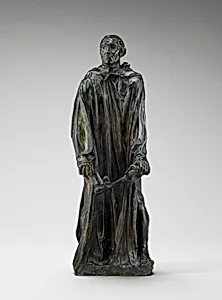
A Burgher of Calais (Jean d'Aire)
model 1884-1889, reduction cast probably 1895
Medium
bronze
Dimensions
overall: 47 x 16 x 14 cm (18 1/2 x 6 5/16 x 5 1/2 in.)
Classification
Sculpture
Department
CSD
Museum
National Gallery of Art, Washington, D.C.
Credit
Gift of Mrs. John W. Simpson
Accession Number
1942.5.13
Rights
Public Domain
Art Historical Context
In the heart of Auguste Rodin's monumental *The Burghers of* (1884–1889) stands Jean d'Aire, one of six citizens who heroically volunteered as hostages in 1347 to spare their besieged city from English King Edward III during the Hundred Years' War This poignant bronze reduction, cast around 1895 from Rodin's original plaster model, captures Jean in a moment of profound sacrifice—barefoot, shirtless, and bearing the city keys, his posture radiating quiet resolve and human vulnerability. At just 47 x 16 x 14 cm, this intimate sculpture allows museum visitors to contemplate the personal drama of history up close. Rodin, a pioneer of modern sculpture, revolutionized the medium by rejecting polished idealism for raw emotional truth. His textured bronze surfaces, achieved through lost-wax casting, evoke the burghers' inner turmoil with flickering light and shadow, drawing from Impressionist influences while honoring Gothic realism. This work exemplifies Rodin's innovative approach: figures emerging dynamically from the material, full of psychological depth rather than heroic posturing. A gift to the National Gallery of Art from Mrs. John W. Simpson, *A Burgher of Calais (Jean d'Aire)* invites us to reflect on courage amid despair, bridging medieval valor with 19th-century innovation. It's a testament to how Rodin's vision transformed public monuments into timeless explorations of the human spirit.
About the Artist
Auguste Rodin · 1840–1917
François Auguste René Rodin (1840-1917) stands as the founder of modern sculpture, transforming the art form from academic tradition into expressive modernism. Born into a working-class Parisian family, Rodin faced early rejection, failing three times to gain admission to the prestigious École des Beaux-Arts. This setback forced him to work as a craftsman for nearly two decades, though his 1875 tr...