
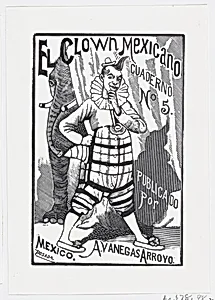
A clown standing with one hand on his hip and an elephant peering out from behind a curtain, illustration for 'El Clown Mexicano (The Mexican Clown)' published by Antonio Vanegas Arroyo
ca. 1880–1910
Medium
Type-metal engraving
Dimensions
Image: 5 1/8 × 3 3/8 in. (13 × 8.6 cm)
Classification
Prints
Department
Drawings and Prints
Museum
Metropolitan Museum of Art, New York, NY
Credit
Gift of Roberto Berdecio, 1960
Accession Number
60.678.98
Rights
Public Domain
Tags
Art Historical Context
In the vibrant world of late 19th- and early 20th-century printmaking, José Guadalupeada captures a whimsical circus moment in this type-metal engraving, *A clown standing with one hand his hip and an elephant out from behind a curtain*. Created around 1880–1910, the image illustrates *El Clown MexicanoThe Mexican Clown)* published by Antonio Vanegas, Posada's longtime collaborator. The bold, high-contrast lines typical of Posada's folk-inspired style depict the confident clown in exaggerated pose, with the elephant's mischievous trunk adding playful surprise—evoking the lively spectacle of traveling circuses that thrilled Mexican audiences. Type-metal engraving, a relief printing technique using metal plates cast from type, allowed for inexpensive mass production of broadsides and chapbooks. This medium democratized art, making Posada's satirical and entertaining works accessible to everyday people through street vendors and markets. At just 5 1/8 × 3 3/8 inches, the compact print packs dramatic flair, blending humor with cultural commentary on popular entertainments. Housed in the Metropolitan Museum of Art's Drawings and Prints department (gift of Roberto Berdecio, 1960), this piece exemplifies Posada's enduring legacy in Mexican graphic arts, bridging folk tradition and modernity while celebrating the joy of clowns and exotic animals in everyday life.
About the Artist
José Guadalupe Posada|José Sanchez · 1852–1913
José Guadalupe Posada (1852-1913) was a Mexican printmaker and engraver who revolutionized popular art and created some of the most iconic images in Mexican culture. Working primarily with publisher Antonio Vanegas Arroyo, he produced over 20,000 images during his career—inexpensive broadsheets sold for a penny on colored paper that made his art accessible to even the poorest workers. He transform...