
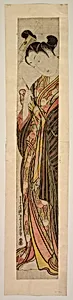
A courtesan holding a pipe
mid–1740s
Medium
Hand-colored woodblock print; hashira-e, beni-e
Dimensions
102.3 × 16.3 cm (40 1/4 × 6 3/8 in.)
Classification
woodblock print
Department
Arts of Asia
Museum
Art Institute of Chicago
Accession Number
26762
Rights
Public Domain
Art Historical Context
In the vibrant world of18th-century Edo Japanmodern-day Tokyo), Okura Masanobu'sA Courtesan Holding Pipe* captures the allure the "floating world"—the uki-e tradition celebrating fleeting pleasures theater, fashion, and romance. Created in the mid-1740s, this hand-colored woodblock print depicts a glamorous courtesan from the Yoshiwara pleasure district, pipe in hand, embodying poise and sensuality. Masanobu, a pioneering ukiyo artist active from the 1710s to 1760s, was for blending Western perspective techniques with Japanese aesthetics, elevating printmaking from utilitarian art to collectible luxury. This hashira-e, or pillar print, stands tall and narrow at 102.3 × 16.3 cm, ideal for hanging on architectural pillars in homes or teahouses. Its beni-e style—using hand-applied red pigments over black outlines—marks an early innovation in color printing before full-color nishiki-e emerged, showcasing Masanobu's mastery of subtle shading and bold lines. The pipe, a tobacco accessory introduced via Dutch trade, hints at cultural exchanges during Japan's isolationist Sakoku period. Housed in the Art Institute of Chicago's Arts of Asia department, this print offers a window into Edo society's fascination with bijin-ga (beautiful women), blending eroticism with everyday elegance. A testament to ukiyo-e's democratic appeal, it made high fashion accessible to urban merchants and samurai alike.
About the Artist
Okumura Masanobu · 1686–1764
Japanese, 1686–1764