
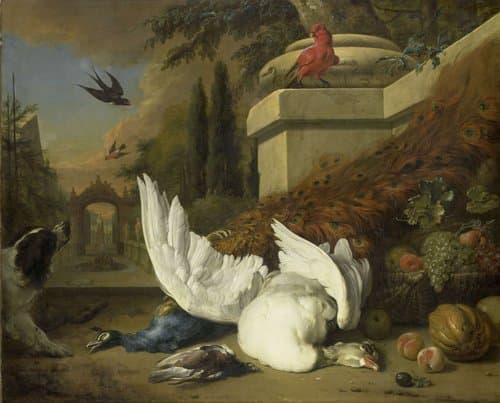
A Dog with a dead Goose and Peacock (A Study of Game and Fruit)
c. 1700
Medium
oil on canvas
Dimensions
14; 170; 139
Rights
Public Domain
About this artwork
oil on canvas
Art Historical Context
In the grand tradition of Dutch Golden Age still lifes, Jan Weenix *A Dog with a Dead and Peacock (A Study Game and Fruit)*, around 1700, captures the opulence and transience of life with masterful realism. Weenix, a leading figure in late 17th-century Dutch, specialized in lavish depictions of hunting trophies, where dead gamebirds like the goose and peacock symbolize both aristocratic leisure and the fleeting nature of earthly pleasures—a subtle nod to vanitas themes. Housed in Amsterdam's Rijksmuseum, this monumental oil on canvas (139 × 170 cm) immerses viewers in a world of abundance, blending still life with a loyal hunting dog that adds narrative warmth and dynamism. Weenix's technique shines in his hyper-realistic rendering of textures: the iridescent feathers of the peacock, the glossy fur of the dog, and scattered fruits evoke trompe l'oeil illusionism, drawing the eye into an almost tangible scene. His dramatic chiaroscuro lighting heightens the three-dimensionality, showcasing his evolution from earlier, more intimate works toward expansive, decorative compositions favored by wealthy patrons for country estates. This piece exemplifies the cultural prestige of game still lifes in early 18th-century Europe, reflecting Holland's prosperity amid shifting tastes toward grandeur. Today, it invites us to marvel at nature's beauty—and its impermanence—through Weenix's enduring gaze.