
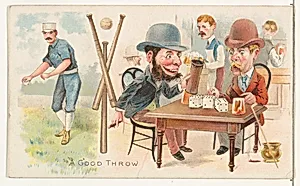
A Good Throw, from the Talk of the Diamond set (N135) issued by Duke Sons & Co., a branch of the American Tobacco Company
Medium
Commercial color lithograph
Dimensions
Sheet: 2 1/2 × 4 1/8 in. (6.4 × 10.4 cm)
Classification
Prints|Ephemera
Department
Drawings and Prints
Museum
Metropolitan Museum of Art, New York, NY
Credit
The Jefferson R. Burdick Collection, Gift of Jefferson R. Burdick
Accession Number
63.350.207.135.23
Rights
Public Domain
Tags
Art Historical Context
In 1888, W. Duke, Sons & Co., a branch of the American Tobacco Company issued the "Talk of the Diamond set (N135), a series of vibrant chromolithograph trading cards celebrating baseball, America's burgeoning national pastime. *A Good Throw* captures the excitement of the sport through a dynamic scene of male athletes—likely players—in action, with tags evoking men playing baseball amid elements like dice, hinting at the era's blend of athletic heroism and casual gambling culture on the diamond. Produced by lithographers Schumacher & Ettlinger, this petite commercial color lithograph (just 2½ × 4⅛ inches) exemplifies ephemera designed for mass appeal, tucked into cigarette packs to entice collectors young and old. Chromolithography's layered printing technique brought vivid colors and sharp details to these affordable cards, making high-energy sports imagery accessible during baseball's explosive growth in the late 19th century. As promotional tools, they fueled the hobby of trading cards while embedding tobacco branding in popular culture. Today, preserved in The Metropolitan Museum of Art's Jefferson R. Burdick Collection, *A Good Throw* offers a window into Gilded Age advertising ingenuity and the sport's role in forging American identity.
About the Artist
W. Duke, Sons & Co.|American Tobacco Company|Schumacher & Ettlinger · 1870–1920
**W. Duke, Sons & Co.: Pioneers of Chromolithographic Trade Card Art** W. Duke, Sons & Co., an American tobacco manufacturer, emerged from the entrepreneurial vision of Washington Duke (1820–1905) and his sons in Durham, North Carolina. After the Civil War, Washington abandoned farming in 1874 to join his eldest son, Brodie L. Duke, in the burgeoning tobacco trade, establishing a factory that for...