
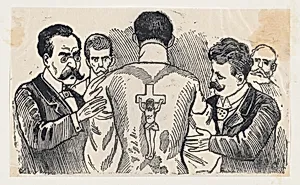
A group of men looking at a man's back with an image of the Crucifixion
ca. 1880–1910
Medium
Zincograph
Dimensions
Sheet: 3 7/16 × 5 11/16 in. (8.8 × 14.5 cm)
Classification
Prints
Department
Drawings and Prints
Museum
Metropolitan Museum of Art, New York, NY
Credit
Gift of Jean Charlot, 1930
Accession Number
30.82.61
Rights
Public Domain
Tags
Art Historical Context
José Guadalupe Posada, a Mexican printmaker active from the late 19th to 20th century, this striking zincograph around 1880–1910. Titled *A Group of Men Looking at a Man's with an Image of theifixion*, the small print (3 7/16 × 5 11/16 in.) depicts a of men intently examining the bare back of another figure, where a vivid image of Christ's Crucifixion miraculously appears. This scene evokes themes of divine revelation and popular piety, common in Mexican devotional art. Posada mastered zincography—a affordable planographic technique akin to lithography but using zinc plates—for mass-producing satirical broadsheets and religious imagery. His bold, black-line style influenced modern Mexican graphics, including Diego Rivera's work and Day of the Dead traditions. Produced during a time of social upheaval leading to the Mexican Revolution, such prints blended faith with everyday wonder, making sacred narratives accessible to the working class. Now in the Metropolitan Museum of Art's Drawings and Prints department (gift of Jean Charlot, 1930), this piece highlights Posada's role in democratizing art, turning zinc into a vehicle for cultural storytelling that captivated Mexico's urban crowds.
About the Artist
José Guadalupe Posada · 1852–1913
José Guadalupe Posada (1852-1913) was a Mexican printmaker and engraver who revolutionized popular art and created some of the most iconic images in Mexican culture. Working primarily with publisher Antonio Vanegas Arroyo, he produced over 20,000 images during his career—inexpensive broadsheets sold for a penny on colored paper that made his art accessible to even the poorest workers. He transform...