
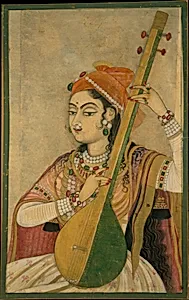
A Lady Playing the Tanpura
Unknown Artist
ca. 1735
Medium
Ink, opaque and transparent watercolor, and gold on paper
Dimensions
18 1/2 x 13 1/4 in. (47 x 33.7 cm)
Classification
Paintings
Culture
India (Rajasthan, Kishangarh)
Department
Asian Art
Museum
Metropolitan Museum of Art, New York, NY
Credit
Fletcher Fund, 1996
Accession Number
1996.100.1
Rights
Public Domain
Tags
Art Historical Context
This elegant painting from around 1735 captures a solitary woman absorbed in playing the tanpura, a long-necked string instrument central to Indian classical music. Created in the princely state of Kishangarh in Rajasthan, it belongs to a rich tradition of courtly miniature painting that flourished in 18th-century India. The unknown artist employed delicate ink lines, layers of opaque and transparent watercolor, and shimmering gold to bring luminous detail to the figure’s flowing garments and the instrument’s graceful curves. Such works often adorned royal albums and reflected the refined tastes of Rajput courts, where music and poetry were highly valued. The tanpura’s resonant drone provided the foundation for melodic performance, and depictions of female musicians highlighted the important role women played in courtly entertainment and devotional arts. The painting’s intimate scale and refined technique exemplify the Kishangarh style, which blended Mughal precision with a lyrical local sensibility. Today housed in the Metropolitan Museum of Art’s Asian Art collection, this piece offers visitors a window into the sensory world of 18th-century Rajasthan, where art, music, and daily elegance intertwined.