
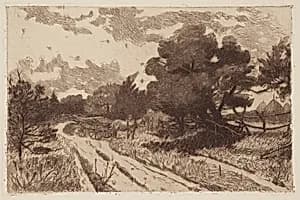
A Long Island Road
Medium
etching
Dimensions
plate: 98 x 147 mm sheet: 240 x 314 mm
Classification
Portfolio
Department
CG-W
Museum
National Gallery of Art, Washington, D.C.
Credit
Reba and Dave Williams Collection, Gift of Reba and Dave Williams
Accession Number
2008.115.2705.7
Rights
Public Domain
Art Historical Context
William Henry Shelton's *A Long Island Road* (1887) captures the serene, everyday beauty of rural America through the intimate medium of etching. Shelton, an American artist active in the late 19th century, specialized in detailed landscapes and genre scenes, often evoking the charm of coastal and countryside locales like Long Island, New York. This print, with its modest plate size of 98 x 147 mm on a larger sheet (240 x 314 mm), invites viewers to trace the winding path through open fields, a quintessential snapshot of post-Civil War pastoral life amid encroaching urbanization. Etching, Shelton's chosen technique, involves incising lines into a metal plate with acid, allowing for rich tonal contrasts and fine textures that mimic drawing. In the 1880s etching revival, American artists like Shelton embraced this Old Master method to elevate printmaking as fine art, producing affordable yet sophisticated works that democratized access to original imagery. Housed in the National Gallery of Art's Reba and Dave Williams Collection (gift of the collectors), this piece from the CG-W Portfolio department reflects the era's fascination with regional identity. It reminds us how such modest roads symbolized freedom and simplicity in Gilded Age America, offering a timeless pause for reflection.