
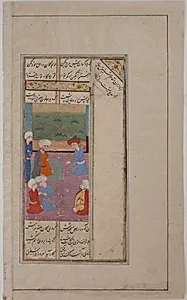
"A Man Complained to Da'ud of a Sufi Mystic Drunk", Folio from a Kulliyat (Complete Works) of Sa'di
Unknown Artist
19th century
Medium
Ink, opaque watercolor, and gold on paper
Dimensions
Painting: H. 9 13/16 in. (24.9 cm) W. 4 13/16 in. (12.2 cm) Page: H. 14 in. (35.6 cm) W. 8 3/8 in. (21.3 cm) Mat:: H. 19 1/4 in. (48.9 cm) W. 14 1/4 in. (36.2 cm)
Classification
Codices
Department
Islamic Art
Museum
Metropolitan Museum of Art, New York, NY
Credit
Gift of Alexander Smith Cochran, 1913
Accession Number
13.228.10.7
Rights
Public Domain
Art Historical Context
This exquisite folio from the 19th-century *Kulliyat* (Complete Works) of the renowned Persian poet Sa'd depicts a whimsical yet profound scene titled *"A Man Complained to'ud of a Sufi Mystic Drunk."*'di (c. 1210–1290), celebrated for his moral fables and mystical poetry in works like the *Bustan* and *Gulistan*, often wove Sufi themes of spiritual ecstasy into everyday anecdotes. Here, a complainant approaches the prophet Da'ud (David), highlighting the cultural trope of the "drunk" Sufi—symbolizing divine intoxication rather than literal inebriation—reflecting Persian literature's blend of humor, ethics, and mysticism. Rendered in the tradition of Persian miniature painting, the unknown artist employed intricate ink outlines, vibrant opaque watercolors, and shimmering gold on paper to create a compact, jewel-like composition (painting: 9 13/16 × 4 13/16 in.). These techniques, hallmarks of Islamic manuscript illumination, emphasize flattened space, stylized figures, and decorative patterns, evoking the opulent codices of Safavid and Qajar eras. As part of the Metropolitan Museum of Art's Islamic Art collection (gift of Alexander Smith Cochran, 1913), it showcases how 19th-century artisans revived classical Persian motifs in devotional texts. This artwork invites visitors to ponder Sufism's tolerant spirit, where apparent folly reveals deeper wisdom, bridging 13th-century poetry with enduring visual storytelling in Islamic culture.