
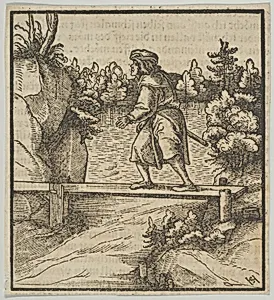
A Man Crossing a Small Bridge, from Hymmelwagen auff dem, wer wol lebt...
Medium
Woodcut
Dimensions
Sheet: 4 3/8 in. × 4 in. (11.1 × 10.2 cm)
Classification
Prints
Department
Drawings and Prints
Museum
Metropolitan Museum of Art, New York, NY
Credit
Purchase, Anne and Carl Stern Gift, 1959
Accession Number
59.507.157(9)
Rights
Public Domain
Tags
Art Historical Context
In the early 16th century, the vibrant Northern Renaissance, German artist Hans Schäufelein a pupil of Albrecht Dürer, created intricate woodcuts that brought moral and devotional themes to the masses. *A Man Crossing a Small* (1517), from the publication *Himmelswagen auff dem, wer wolbt...* (Heavenly Chariot the Path of Those Who Live Well exemplifies this tradition. Printed on a modest sheet measuring just 4 3/8 × 4 inches, this woodcut captures a solitary figure navigating a humble bridge, evoking themes of life's precarious journey toward spiritual salvation. Woodcuts like this were revolutionary for their accessibility—carved in relief on wooden blocks and inked for mass production in books, they democratized art amid the printing press boom. Schäufelein's precise line work, possibly with contributions from printers Hans von Leonrodt and Silvan Otmar, renders dynamic tension in the man's stride and the bridge's delicate arch, blending everyday realism with symbolic depth. Bridges often signified transitions in Renaissance imagery, making this print a poignant meditation on perseverance. Today, housed in the Metropolitan Museum of Art's Drawings and Prints department (purchased via the Anne and Carl Stern Gift in 1959), it invites visitors to ponder how such tiny treasures illuminated faith and folklore for everyday folk five centuries ago.
About the Artist
Hans Schäufelein|Hans von Leonrodt|Silvan Otmar · 1480–1540
Hans Schäufelein (c. 1480–c. 1540) was a German painter and graphic artist of the Northern Renaissance whose career placed him at the heart of one of the most dynamic artistic environments in European history. As a young man, he entered the workshop of Albrecht Dürer in Nuremberg, an experience that proved decisive: Dürer's meticulous approach to draughtsmanship, his mastery of printmaking, and hi...