
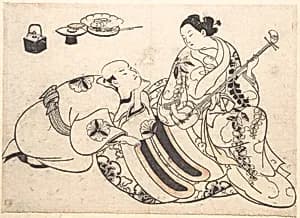
A Man in a Kneeling Posture Bending Forward and Listening to an Oiran who is Playing the Shamisen
ca. 1705–7
Medium
Woodblock print; ink and color on paper
Dimensions
9 15/32 x 13 1/4 in. (24.1 x 33.7 cm)
Classification
Prints
Culture & Period
Japan · Edo period (1615–1868)
Department
Asian Art
Museum
Metropolitan Museum of Art, New York, NY
Credit
The Francis Lathrop Collection, Purchase, Frederick C. Hewitt Fund, 1911
Accession Number
JP685
Rights
Public Domain
Tags
Art Historical Context
In the vibrant world of Edo-period Japan (1615–1868), Okumura Masanobu's woodblock print *A Man in a Kne Posture Bending Forward Listening to an Oiran is Playing the Shamisen (ca. 1705–7) captures a moment of intimate entertainment. This 9 15/32 x 13 1/4 in. ink and color print on paper exemplifies early ukiyo-e ("pictures of the floating world"), the pleasures of urban life in Tokyo's Yoshiwara pleasure district. Here a rapt man kneels in deference, leaning forward as a glamorous oiran—Japan's high-ranking courtesan—strums the shamisen, a three-stringed lute symbolizing geisha culture and refined artistry. Masanobu, a pioneering printmaker active around 1700–60, innovated with techniques like urushi-e (lacquer-like gloss) and early color layering, making his works pop with lush reds, blacks, and subtle gradients. This piece reflects the era's booming print industry, where affordable images democratized depictions of celebrities, theater, and romance for commoners. The oiran's elaborate kimono and poised elegance highlight gender dynamics and the allure of the demimonde, offering viewers a window into Japan's sophisticated leisure class. Held in the Metropolitan Museum of Art's Asian Art collection (The Francis Lathrop Collection, 1911), this print not only showcases Masanobu's technical flair but also preserves the ephemeral charm of Edo's nightlife, inviting us to eavesdrop on history's melodies.
About the Artist
Okumura Masanobu · 1686–1764
Japanese, 1686–1764