
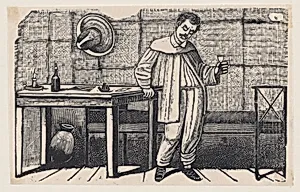
A man with a glass in his hand looking downwards and leaning on a table, an illustration from 'El huérfano'
ca. 1880–1910
Medium
Type-metal engraving
Dimensions
Sheet: 3 9/16 × 5 1/2 in. (9 × 14 cm)
Classification
Prints
Department
Drawings and Prints
Museum
Metropolitan Museum of Art, New York, NY
Credit
Gift of Jean Charlot, 1930
Accession Number
30.82.80
Rights
Public Domain
Tags
Art Historical Context
José Guadalupe Posada, a Mexican printmaker active from the late 19th to early 20th century, captures a poignant moment of melancholy in this type-metal engraving from *El huérfano* (The Orphan), circa 1880–1910. The image depicts a solitary man, glass in hand, gazing downward while leaning heavily on a table—a stark portrayal of introspection amid drink. Created for popular broadsheets and publications in Mexico City, Posada's works often infused everyday scenes with sharp social commentary, reflecting the struggles of ordinary folk during the Porfiriato era, a time of rapid modernization shadowed by inequality and vice. Rendered in the humble yet expressive medium of type-metal engraving—a relief printing technique using metal plates typically for newspapers—Posada's small-scale print (3 9/16 × 5 1/2 in.) exemplifies his folk-art style. Bold lines and high contrast evoke the dramatic chiaroscuro of broadside illustrations, making complex emotions accessible to a wide, often illiterate audience through visual storytelling. Housed in the Metropolitan Museum of Art's Drawings and Prints department (gift of Jean Charlot, 1930), this piece highlights Posada's enduring influence on Mexican graphic art and Day of the Dead iconography. Though subtle here, his satirical lens on themes like drinking underscores cultural critiques that resonated with the working class, bridging art and social discourse.
About the Artist
José Guadalupe Posada · 1852–1913
José Guadalupe Posada (1852-1913) was a Mexican printmaker and engraver who revolutionized popular art and created some of the most iconic images in Mexican culture. Working primarily with publisher Antonio Vanegas Arroyo, he produced over 20,000 images during his career—inexpensive broadsheets sold for a penny on colored paper that made his art accessible to even the poorest workers. He transform...