
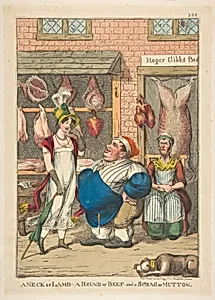
A Neck of Lamb, a Round of Beef, and a Scrag of Mutton
Medium
Hand-colored etching
Dimensions
sheet: 13 3/4 x 10 in. (35 x 25.4 cm)
Classification
Prints
Department
Drawings and Prints
Museum
Metropolitan Museum of Art, New York, NY
Credit
The Elisha Whittelsey Collection, The Elisha Whittelsey Fund, 1959
Accession Number
59.533.1810
Rights
Public Domain
Tags
Art Historical Context
In the bustling world of Regency-era Britain, Charles Williams, a caricaturist, created *A Neck of Lamb, Round of Beef, and Scrag of Mutton* in 1816, by Thomas Tegg, a key figure in London's satirical print trade. This hand-colored etching, measuring 13¾ x 10 inches, exemplifies the affordable yet vivid medium popular for disseminating humor and social commentary. Hand-coloring by skilled artisans brought lively tones to the black-line etchings, making them stand out in shops and homes, much like today's viral memes. The title playfully nods to common cuts of meat, while the scene bursts with butchers, men, women, and dogs in a chaotic marketplace satire. Likely poking fun at inflated prices, dishonest traders, or everyday economic woes amid post-Napoleonic recovery, it captures the era's tensions over food costs and urban life. Williams's exaggerated style aligns with the British caricature tradition, from Hogarth to Cruikshank, using wit to critique society without restraint. Housed in the Metropolitan Museum of Art's Elisha Whittelsey Collection, this print highlights how satire served as a democratic mirror to 19th-century Britain, blending sharp observation with accessible artistry for all classes.
About the Artist
Charles Williams|Thomas Tegg · 1797–1830
Charles Williams (1797–1830) was a British caricaturist and printmaker who worked in London during the final decades of the Georgian era, producing satirical prints for the thriving trade in political and social caricature that flourished in the city's print shops. He worked in the tradition established by such masters as James Gillray and Thomas Rowlandson, whose biting visual commentary on polit...