
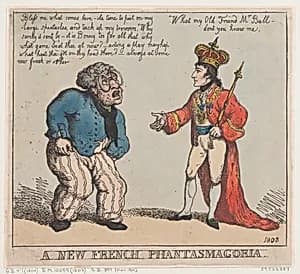
A New French Phantasmagoria
Medium
Hand-colored etching
Dimensions
Sheet: 10 1/4 × 11 5/16 in. (26 × 28.7 cm)
Classification
Prints
Department
Drawings and Prints
Museum
Metropolitan Museum of Art, New York, NY
Credit
The Elisha Whittelsey Collection, The Elisha Whittelsey Fund, 1959
Accession Number
59.533.887
Rights
Public Domain
Tags
Art Historical Context
Step into the lively world of early 19th-century British satire with *A New French Phantasmag*, a hand-colored etching in 1803 by renowned caricaturists Thomas Rowlandson and Georgeurgatroyd Woodward. just 10¼ × 11½ inches, this compact print packs a punch, blending sharp wit with vivid color to mock Napoleon Bonaparte, the rising French emperor. Hand-coloring, a hallmark of the era's popular prints, heightened their appeal and emotional impact, making them affordable spectacles for the public. Created amid the Napoleonic Wars, when Britain viewed Napoleon as a tyrannical threat, the title evokes "phantasmagoria"—those thrilling magic lantern shows projecting ghostly illusions. Here, Rowlandson and Woodward likely conjure Napoleon's grandiose ambitions as fleeting phantoms, satirizing his political maneuvers through exaggerated, humorous imagery of men in chaotic scenes. This reflects the golden age of British caricature, where prints served as potent political commentary, accessible to all classes. Housed in the Metropolitan Museum of Art's Drawings and Prints department, this work exemplifies how etching enabled quick, biting critiques of power. Its enduring charm lies in capturing a moment when art became a weapon of ridicule, reminding us how satire shapes public opinion.
About the Artist
Thomas Rowlandson|George Murgatroyd Woodward|Napoléon Bonaparte · 1756–1827
Thomas Rowlandson (1757–1827) was an English artist and caricaturist whose satirical watercolors and prints captured the social life of Georgian Britain with unparalleled wit and technical mastery. Alongside James Gillray, he is recognized as one of the greatest British graphic artists, and his distinctive flowing line and keen observations have made his work integral to understanding late 18th an...