
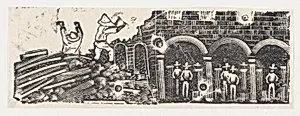
A pair of workers atop a pile of rubble and other workers watching them
ca. 1880–1910
Medium
Type-metal engraving
Dimensions
Sheet: 1 9/16 × 4 3/4 in. (4 × 12 cm)
Classification
Prints
Department
Drawings and Prints
Museum
Metropolitan Museum of Art, New York, NY
Credit
Gift of Jean Charlot, 1930
Accession Number
30.82.56
Rights
Public Domain
Tags
Art Historical Context
José Guadalupe Posada, a Mexican printmaker active from the late 19th to early 20th century, the grit of everyday life in this type-metal engraving, titled *A pair of workers atop a pile rubble and other workers watching* (ca. 1880–1910). The small-scale print (just 1 9/16 × 4 3/4 in.) depicts a group of laborers amid urban debris, with two men perched precariously on a mound while others gaze upward. Posada's bold, economical lines evoke the chaos of construction or disaster recovery, reflecting Mexico's rapid modernization during the Porfiriato era. Renowned for his satirical broadsheets and iconic calaveras (skeleton imagery), Posada blended folk art with social commentary, using affordable relief printing techniques like type-metal engraving to produce mass-distributed zincographs and relief prints. This medium allowed crisp black-and-white contrasts on cheap paper, making his work accessible to the working class he often portrayed. His images critiqued inequality, labor struggles, and political events leading to the Mexican Revolution (1910–1920), immortalizing ordinary people in dramatic vignettes. Today, this intimate print, a 1930 gift from artist Jean Charlot to the Metropolitan Museum of Art, exemplifies Posada's enduring influence on Mexican graphic arts and modernists like Diego Rivera. It invites visitors to ponder the dignity and peril of manual labor in a transforming society.
About the Artist
José Guadalupe Posada · 1852–1913
José Guadalupe Posada (1852-1913) was a Mexican printmaker and engraver who revolutionized popular art and created some of the most iconic images in Mexican culture. Working primarily with publisher Antonio Vanegas Arroyo, he produced over 20,000 images during his career—inexpensive broadsheets sold for a penny on colored paper that made his art accessible to even the poorest workers. He transform...