
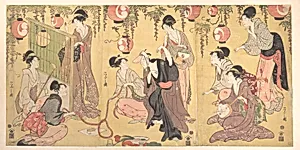
A Parody of Yuranosuke in the Pleasure Quarters
ca. 1797
Medium
Triptych of woodblock prints; ink and color on paper
Dimensions
14 3/8 x 30 in. (36.5 x 76.2cm)
Classification
Prints
Culture & Period
Japan · Edo period (1615–1868)
Department
Asian Art
Museum
Metropolitan Museum of Art, New York, NY
Credit
Gift of Estate of Samuel Isham, 1914
Accession Number
JP952
Rights
Public Domain
Tags
Art Historical Context
In the vibrant world of Edo-period Japan (1615–1868), Chōbunsai Eishi crafted *A Parody of Yuruke in the Pleasure Qu* around 1797, a delightful triptych of woodblock prints in ink and color on paper. panoramic artwork, measuring 14 3/8 x 30 inches, humorously reimagines Ōboshi Yuranos—a heroic figure from the famous kabuki play *Chūshingura* (Treasury of the Loyal Retainers)—transplanted into the glamorous Yoshiwara pleasure district. Eishi, a master of the ukiyo-e ("pictures of the floating world") tradition, blends theater parody with scenes of courtesans and patrons, capturing the era's fascination with kabuki drama and urban nightlife. Eishi's refined style shines through in the elegant lines and subtle color gradients achieved via woodblock printing, a technique where intricate blocks were carved for each hue and inked by hand. Triptychs like this allowed for expansive, immersive compositions, popular among collectors for their narrative depth. The print's playful twist on loyalty and revenge themes reflects Edo Japan's love for satire, poking fun at samurai ideals amid hedonistic revelry. Housed in the Metropolitan Museum of Art's Asian Art Department, this piece exemplifies ukiyo-e's cultural role in democratizing art—affordable prints brought high-society glamour to everyday viewers, preserving a snapshot of 18th-century Japanese wit and beauty.
About the Artist
Chōbunsai Eishi · 1756–1829
Japanese, 1756–1829