
A Part of the Forest of Fontainebleau
Medium
Etching and drypoint on ivory chine laid down on ivory laid paper
Dimensions
Image/plate: 8.5 × 13.5 cm (3 3/8 × 5 3/8 in.); Chine: 8.6 × 13.6 cm (3 7/16 × 5 3/8 in.); Sheet: 12.6 × 20.9 cm (5 × 8 1/4 in.)
Classification
etching
Department
Prints and Drawings
Museum
Art Institute of Chicago
Accession Number
45725
Rights
Public Domain
Art Historical Context
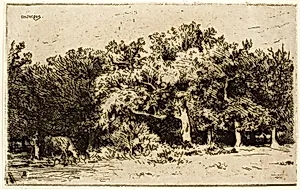
**A Part of the Forest Fontainebleau** Émile Jacque, 1849 Etching and drypoint ivory chine laid down ivory laid paper Art Institute of Chicago, Prints and Drawings Nestled in the heart of France's Fontainebleau Forest, this intimate etching by Charles Émile Jacque captures wild, untamed beauty that captivated 19th-century artists. Jacque, a key figure in the Barbizon School precursor to Impressionism—specialized in rustic landscapes and pastoral scenes, often depicting the dense woodlands near Paris where painters like Théodore Rousseau and Jean-François Millet sought inspiration from nature's raw vitality. Created in 1849, amid the Romantic era's embrace of the sublime, the print reflects the growing fascination with plein air observation, inviting viewers to wander through shadowed trees and undergrowth. Jacque's mastery shines in his etching and drypoint technique: etching creates precise, fluid lines via acid on a metal plate, while drypoint's direct needle scratches produce velvety burrs for rich texture and depth. Printed on delicate ivory chine collé—thin Chinese paper adhered to sturdier laid support—this method ensured fine detail without ink bleed, a hallmark of 19th-century printmaking prized for its affordability and reproducibility. At just 8.5 × 13.5 cm, it exemplifies how prints democratized art, bringing Fontainebleau's timeless allure to collectors worldwide. (198 words)