
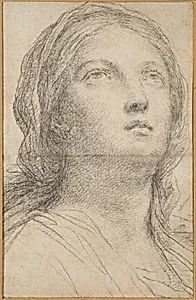
A pious woman, in bust-length, three-quarter view, with head raised to the upper right
late 17th–early 18th century
Medium
Black chalk on white antique laid paper
Dimensions
6 5/8 × 4 1/4 in. (16.8 × 10.8 cm)
Classification
Drawings
Department
Drawings and Prints
Museum
Metropolitan Museum of Art, New York, NY
Credit
Bequest of Harvey Salzman, 2020
Accession Number
2022.25.14
Rights
Public Domain
Art Historical Context
This delicate black chalk drawing on antique laid paper captures a pious woman in bust-length, her head raised in three-quarter view to the upper right evoking quiet devotion. Attributed to Carlo Dolci an anonymous Italian artist from the late 17th to early 18th century, it the Florentine Baroque tradition. Dolci, renowned for his meticulous religious portraits, often depicted saints and devout figures with expressive serenity, blending realism with spiritual intensity during the Counter-Reformation era when art served to inspire faith. The intimate scale—measuring just 6 5/8 × 4 1/4 inches—suggests it was a preparatory study or private devotional sketch, common among Italian draftsmen. Black chalk allowed for soft modeling of flesh tones and drapery, creating subtle shadows that convey introspection and grace. Such works highlight the era's emphasis on emotional piety, bridging painting and drawing in workshops where artists refined compositions for larger canvases. Recently acquired through the Bequest of Harvey Salzman in 2020 at The Metropolitan Museum of Art, this drawing invites visitors to ponder the personal spirituality of Baroque Italy, where even a simple sketch could stir the soul.