
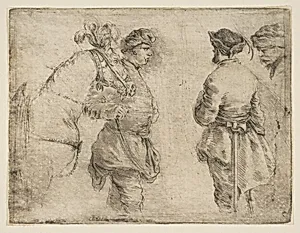
A Pole Leading a Horse by the Bridle and Speaking with Two Other Men
ca. 1662
Medium
Etching
Dimensions
Sheet (trimmed to plate): 3 1/16 × 4 1/16 in. (7.7 × 10.3 cm)
Classification
Prints
Department
Drawings and Prints
Museum
Metropolitan Museum of Art, New York, NY
Credit
The Elisha Whittelsey Collection, The Elisha Whittelsey Fund, 1949, by exchange
Accession Number
68.741.1
Rights
Public Domain
Tags
Art Historical Context
In the intimate etching *A Pole Leading a Horse by the Bridle and Speaking with Two Other Men*, created around 1662 by the Italian artist Stefano della Bella, we glimpse a lively roadside encounter. Della Bella, a master of Baroque printmaking active in Florence and Paris, captures three men—one identifiable as a Polish figure by his attire—engaged in animated conversation, with the central figure gently leading a horse. The small scale (just over 3 by 4 inches) draws viewers close, emphasizing the everyday humanity in this chance meeting amid equestrian life. Etching, Della Bella's preferred medium, allowed for exquisite detail through acid-bitten lines on a metal plate, producing rich textures in fur, fabric, and expressions. A protégé of Jacques Callot and admirer of Rembrandt, he excelled in such genre scenes, blending narrative vigor with technical precision. This print exemplifies 17th-century printmaking's rise as an accessible art form, enabling widespread sharing of vivid, observational moments. Housed in the Metropolitan Museum of Art's Elisha Whittelsey Collection, the work reflects Baroque interest in diverse cultures and travel—Poland's Eastern flair adding exotic intrigue to Della Bella's European vignettes. It's a charming window into 17th-century social exchanges, where horses symbolized mobility and camaraderie.
About the Artist
Stefano della Bella · 1610–1664
Stefano della Bella (1610-1664) was one of the most prolific and versatile printmakers of the Italian Baroque period, leaving behind 1,052 prints and several thousand drawings that captured the vivid essence of 17th-century European life. Born in Florence on May 18, 1610, to a family of artists, he trained initially as a goldsmith before studying painting under Cesare Dandini and etching under Rem...