
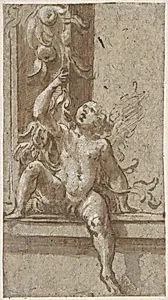
A Putto Seated on a Frame
ca. 1538–40
Medium
Pen and brown ink, brush and brown wash, highlighted with white gouache, over traces of leadpoint or black chalk
Dimensions
sheet: 4 3/4 x 2 9/16 in. (12 x 6.5 cm)
Classification
Drawings
Department
Drawings and Prints
Museum
Metropolitan Museum of Art, New York, NY
Credit
Gift of Philippe and Edith de Montebello, 2008
Accession Number
2008.334.2
Rights
Public Domain
Tags
Art Historical Context
Girolamo Mazzola Bedoli, a Mannerist artist active in sixteenth-century Parma, created this delicate drawing around 1538–40. Closely associated with his celebrated relative Parmigianino, Bedoli worked in the refined, graceful style that defined Emilian Mannerism. The small sheet depicts a charming putto perched atop an ornate frame, a motif frequently used to enliven the borders of altarpieces, frescoes, and decorative schemes. Executed in pen and brown ink with brush and wash, accented by white gouache highlights, the drawing demonstrates the artist’s mastery of light and volume on a modest scale. Such preparatory studies allowed Bedoli to explore the playful pose and sculptural presence of the figure before translating it into paint or stucco. Putti like this one symbolized innocence and divine joy, adding a sense of movement and whimsy to sacred or mythological compositions. Acquired by the Metropolitan Museum of Art in 2008 as a gift from Philippe and Edith de Montebello, the work offers visitors an intimate glimpse into the creative process behind the elaborate decorative programs of the Italian Renaissance.