
A Reconstruction of the Temple of Divus Claudius in Monte Coelio (above) and a View of the Ruins (below)
before 1704
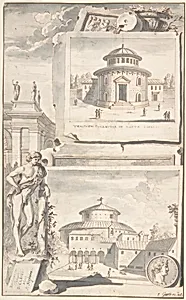
Medium
Red chalk, pen and black ink, brush and gray wash
Dimensions
13 x 8 7/64 in. (33.0 x 20.6 cm)
Classification
Drawings
Department
Drawings and Prints
Museum
Metropolitan Museum of Art, New York, NY
Credit
Gift of Helen and János Scholz, 1958
Accession Number
58.648.2(33)
Rights
Public Domain
Tags
Art Historical Context
Jan Goeree's *A Reconstruction of the Temple of Divus Claudius in Monte Coelio (above) and a View of the Ruins (below)*, created before 1704, captures the allure of ancient Rome through meticulous draftsmanship. This Dutch artist's drawing juxtaposes an imagined pristine reconstruction of the temple—dedicated to Emperor Claudius on Rome's Caelian Hill—with the poignant reality of its weathered ruins below. Goeree, trained in a family of artists and engravers, reflects the 17th-century fascination with classical antiquity, fueled by scholars and travelers documenting Rome's imperial past amid the emerging Grand Tour era. The Temple of Divus Claudius, built by Emperor Vespasian around 79 CE to honor the deified Claudius, symbolized Rome's imperial grandeur but fell into decay over centuries. Goeree's dual view highlights this temporal contrast, blending scholarly reconstruction with on-site observation—a common practice among antiquarians like Piranesi's predecessors. Such works preserved vanishing heritage, informing architects and fueling neoclassical revivals. Rendered in red chalk for subtle modeling, pen and black ink for precise lines, and brush with gray wash for atmospheric depth, the 13 x 8-inch sheet exemplifies Baroque-era topographic precision. Now at The Metropolitan Museum of Art (gift of Helen and János Scholz, 1958), it invites visitors to ponder Rome's enduring legacy, bridging past glory and present ruin.
About the Artist
Jan Goeree · 1670–1731
Comment on works: Painter; Draughtsman; Engraver; History; Subjects in landscapes