
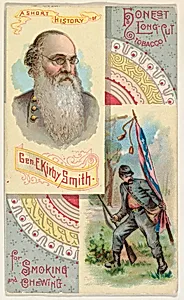
A Short History of General E. Kirby Smith, from the Histories of Generals series (N114) issued by W. Duke, Sons & Co. to promote Honest Long Cut Smoking and Chewing Tobacco
Medium
Commercial color lithograph
Dimensions
Sheet: 4 3/16 × 2 1/2 in. (10.7 × 6.4 cm)
Classification
Prints|Ephemera
Department
Drawings and Prints
Museum
Metropolitan Museum of Art, New York, NY
Credit
The Jefferson R. Burdick Collection, Gift of Jefferson R. Burdick
Accession Number
63.350.206.114.181
Rights
Public Domain
Tags
Art Historical Context
This vibrant chromolithograph, titled *A Short History of General E. Smith*, is a gem from the 1888 *Histories of Generals series (N114), by W. Duke, & Co. alongside Knapp & Company. Issued as a promotional insert for Honest Long Cut Smoking and Che Tobacco, this petite card—measuring just 4 3/16 × 2 1/2 inches—captures the profile of Confederate General Edmund Kirby Smith, a key in the Civil War who commanded the Trans-Mississippi Department until the war's end. Such ephemera blended patriotism with commerce, capitalizing on postwar nostalgia for military heroes to entice collectors and consumers. Chromolithography, the medium here, revolutionized 19th-century printing by allowing vivid, multi-color images to be mass-produced affordably, making art accessible beyond elite galleries. Duke's tobacco firm pioneered these "trade cards," distributing millions to build brand loyalty amid fierce competition. This example, from the Metropolitan Museum of Art's Jefferson R. Burdick Collection, exemplifies how everyday objects preserved cultural memory. Today, it offers a window into Gilded Age advertising's ingenuity, where Civil War icons like Smith—tagged simply as "Men, Profiles, Generals"—endorsed smoker's delights, reflecting America's enduring fascination with its divided past.
About the Artist
W. Duke, Sons & Co.|Knapp & Company · 1870–1920
**W. Duke, Sons & Co.: Pioneers of Chromolithographic Trade Card Art** W. Duke, Sons & Co., an American tobacco manufacturer, emerged from the entrepreneurial vision of Washington Duke (1820–1905) and his sons in Durham, North Carolina. After the Civil War, Washington abandoned farming in 1874 to join his eldest son, Brodie L. Duke, in the burgeoning tobacco trade, establishing a factory that for...