
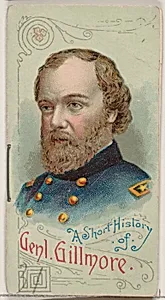
A Short History of General Quincy Adams Gilmore, from the Histories of Generals series of booklets (N78) for Duke brand cigarettes
Medium
Commercial color lithograph
Dimensions
Overall (Booklet closed): 2 3/4 × 1 1/2 in. (7 × 3.8 cm) Overall (Booklet open): 2 3/4 × 2 7/8 in. (7 × 7.3 cm)
Classification
Prints|Ephemera
Department
Drawings and Prints
Museum
Metropolitan Museum of Art, New York, NY
Credit
The Jefferson R. Burdick Collection, Gift of Jefferson R. Burdick
Accession Number
63.350.204.78.14
Rights
Public Domain
Tags
Art Historical Context
In the late 19th century, American tobacco companies like W. Duke, Sons & Co. revolutionized marketing by inserting collectible cards and booklets into cigarette packs turning everyday purchases into a hunt for history and heroes. This tiny 1888 pamphlet, *A Short History of General Adams Gilmore*, is a from their "Histories of Gener" series (N78). Printed as a commercial color lithograph Knapp & Company, it folds to just 2¾ × 1½ inches—perfectly pocket-sized for enthusiasts. Featuring a portrait of Union Civil War general Quincy Adams Gilmore, known for his engineering feats during the Siege of Charleston, it offered bite-sized biographies that celebrated post-war patriotism. Chromolithography, the vibrant printing technique used here, allowed mass production of colorful, detailed images at low cost, making high-quality ephemera accessible to the masses. This blend of portraiture and narrative captured the era's fascination with military leaders, blending education with clever advertising. Today, preserved in the Metropolitan Museum of Art's Jefferson R. Burdick Collection, this delicate survivor highlights how commerce shaped popular culture, inviting us to ponder the generals who shaped a nation—one cigarette at a time.
About the Artist
W. Duke, Sons & Co.|Knapp & Company · 1870–1920
**W. Duke, Sons & Co.: Pioneers of Chromolithographic Trade Card Art** W. Duke, Sons & Co., an American tobacco manufacturer, emerged from the entrepreneurial vision of Washington Duke (1820–1905) and his sons in Durham, North Carolina. After the Civil War, Washington abandoned farming in 1874 to join his eldest son, Brodie L. Duke, in the burgeoning tobacco trade, establishing a factory that for...