
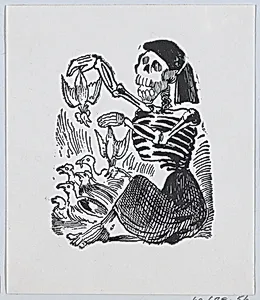
A skeleton selling plucked chickens from a broadside entitled 'Una Calavera Chusca'
ca. 1880–1910
Medium
Zincograph
Dimensions
Sheet: 4 1/4 × 3 9/16 in. (10.8 × 9 cm) Image: 3 1/8 × 2 3/8 in. (8 × 6 cm)
Classification
Prints
Department
Drawings and Prints
Museum
Metropolitan Museum of Art, New York, NY
Credit
Gift of Roberto Berdecio, 1960
Accession Number
60.678.56
Rights
Public Domain
Tags
Art Historical Context
In the whimsical yet macabre world of José Guadalupe Posada prints, *A Skeleton Selling Plucked Chickens from the broadside *Una Calavera Chus* (ca. 1880–1910) captures the artist's signature blend of satire and social commentary. Posada, pioneering Mexican printmaker, depicts a grinning skeleton hawking naked chickens in a bustling market scene, poking fun at everyday commerce through the lens of death. This tiny zincograph—measuring just 4¼ × 3⁹⁄₁₆ inches—exemplifies the broadside tradition, affordable single-sheet publications that brought art to the masses in late 19th- and early 20th-century Mexico. Zincography, Posada's preferred technique, involved etching designs onto zinc plates for high-volume lithographic printing, allowing his bold black-line illustrations to proliferate via newspapers and street vendors. Working primarily for publisher Antonio Vanegas Arroyo during the Porfiriato era, Posada's *calaveras* (skeletons) became icons of Mexican folk art, democratizing themes of mortality and critiquing societal hypocrisies with irreverent humor. Today, this piece from the Metropolitan Museum of Art's Drawings and Prints collection highlights Posada's enduring influence on Day of the Dead imagery and modern Mexican graphics. Imagine a skeletal vendor calling out deals—death sells too, but with a cheeky wink!
About the Artist
José Guadalupe Posada|José Sanchez · 1852–1913
José Guadalupe Posada (1852-1913) was a Mexican printmaker and engraver who revolutionized popular art and created some of the most iconic images in Mexican culture. Working primarily with publisher Antonio Vanegas Arroyo, he produced over 20,000 images during his career—inexpensive broadsheets sold for a penny on colored paper that made his art accessible to even the poorest workers. He transform...