
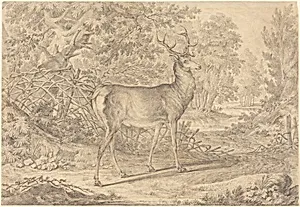
A Splendid Young Stag before a Wattle Fence
Medium
graphite and gray wash on laid paper
Dimensions
overall: 27 x 39.2 cm (10 5/8 x 15 7/16 in.)
Classification
Drawing
Department
CG-E
Museum
National Gallery of Art, Washington, D.C.
Credit
Ailsa Mellon Bruce Fund
Accession Number
2006.146.1
Rights
Public Domain
Art Historical Context
Johann Elias Ridinger, a leading German artist of the 18th century, crafted *A Splendid Young St before a Wattle Fence* in 1736, his mastery of animal portraiture. This graphite and gray wash drawing on laid paper (27 x 39.2 cm) depicts a majestic young stag standing alert against a simple woven wattle fence, evoking the wild elegance of European wildlife. Ridinger, based in Augsburg, was renowned for his naturalistic studies of horses, deer, and hunting scenes, which appealed to aristocratic patrons fascinated by the hunt and natural history during the Rococo era. The artwork's technique highlights Ridinger's precision: graphite provides crisp outlines and fine details in the stag's musculature and antlers, while subtle gray wash adds tonal depth and atmospheric modeling, creating a sense of life and texture on the modest laid paper. This combination allowed for quick yet refined sketches, often preparatory for his famous etchings and engravings. Housed in the National Gallery of Art's CG-E Department through the Ailsa Mellon Bruce Fund, this drawing exemplifies Ridinger's contribution to the animalier tradition, bridging art and emerging scientific observation in the Enlightenment. It invites visitors to appreciate the artistry in everyday natural subjects, frozen in a moment of poised splendor.
About the Artist
Johann Elias Ridinger · 1698–1767
Johann Elias Ridinger (1698–1767) was born in Ulm into an artistic family, the son of scribe and artist Johann Daniel Ridinger and Regina Catharina Miller. He received his initial training in Ulm under the painter Christoph Resch, who instructed him in perspective, geometry, and architecture while assigning preparatory tasks like painting wax models. Around 1713, Ridinger moved to Augsburg, where ...