
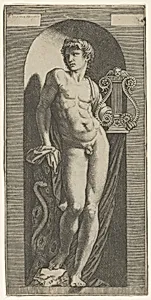
A statue of Apollo, naked standing in a niche, holding a lyre in his left hand and leaning on a tree trunk
Medium
Engraving
Dimensions
8 11/16 x 4 1/4 in. (22.1 x 10.8 cm)
Classification
Prints
Department
Drawings and Prints
Museum
Metropolitan Museum of Art, New York, NY
Credit
The Elisha Whittelsey Collection, The Elisha Whittelsey Fund, 1949
Accession Number
49.97.116
Rights
Public Domain
Tags
Art Historical Context
Behold the graceful engraving *A Statue of Apollo, Naked Standing in aiche, Holding a Ly in His Left Hand and Leaning on a Tree*, a masterful collaboration between High Renaissance genius Raphael (Raffaellozio) and engraver Marcantonio Raim, created between 1512 and 1515. Housed in the Metropolitan Museum of Art's Drawings and Prints department as part of The Elisha Whittelsey Collection, this intimate print measures just 8 11/16 x 4 1/4 inches, yet captures monumental classical poise. Raimondi, renowned for translating Raphael's fluid designs into precise engravings, incised fine lines into a metal plate to produce this image, revolutionizing art dissemination in the Renaissance. The nude Apollo—god of music, poetry, and light—stands elegantly in a niche, lyre in hand and body arched against a tree trunk, evoking ancient Greek sculptures while embodying Raphael's harmonious ideal of beauty and proportion. This work exemplifies the era's revival of antiquity, making elite Vatican imagery accessible to collectors across Europe. Its tags highlight Apollo and the lyre, underscoring themes of artistic inspiration that resonated in Raphael's own frescoes, like those in the Stanza della Segnatura. A testament to printmaking's power, it invites us to ponder the enduring allure of the divine musician.
About the Artist
Marcantonio Raimondi|Raphael (Raffaello Sanzio or Santi) · 1475–1534
Marcantonio Raimondi (c. 1480–1534), born near Bologna, Italy, emerged as one of the Renaissance's premier engravers, revolutionizing printmaking through his mastery of reproductive techniques. He trained in the workshop of the goldsmith, painter, and niellist Francesco Francia, whose influence is evident in his early engravings, such as the goldsmith-like shading in *Pyramus and Thisbe* (1505), h...