
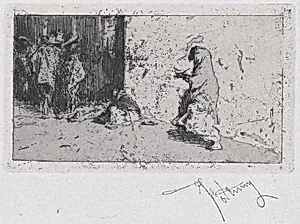
A street in Seville with figures
ca. 1860–70
Medium
Etching
Dimensions
Sheet: 9 5/8 × 12 13/16 in. (24.5 × 32.5 cm) Plate: 2 1/4 × 3 15/16 in. (5.7 × 10 cm)
Classification
Prints
Department
Drawings and Prints
Museum
Metropolitan Museum of Art, New York, NY
Credit
Gift of Junius S. Morgan, 1923
Accession Number
23.106.5
Rights
Public Domain
Tags
Art Historical Context
Mariano Fortuny (1838–1874), a masterful Spanish artist celebrated for his luminous genre scenes and intricate details, captures the vibrant everyday life of Seville in this, *A Street in Seville with Figures* (ca. 1860–70). Fortuny, often associated with Romanticism and emerging Realism, drew inspiration from his travels across Spain and North Africa,using his works with a sense of exotic warmth and human vitality. Here, the narrow street teems with figures—likely locals in traditional attire—evoking the bustling atmosphere of 19th-century Andalusia, a region rich in cultural crossroads between Europe, Africa, and the Islamic world. As an etching, this print showcases Fortuny's virtuoso technique: fine lines incised into a metal plate with acid, allowing for delicate textures in architecture, clothing folds, and shadowed alleys. The modest plate size (2¼ × 3⅞ in.) contrasts with the larger sheet, highlighting the intimacy of printmaking, which made his detailed visions accessible beyond oil paintings. Housed in the Metropolitan Museum of Art's Drawings and Prints department (gift of Junius S. Morgan, 1923), it exemplifies Fortuny's ability to distill cultural snapshots into enduring, jewel-like compositions that enchant viewers with their precision and narrative charm.
About the Artist
Mariano Fortuny, 1838–1874 (Spanish) · 1838 –1874
Spanish, 1838–1874