
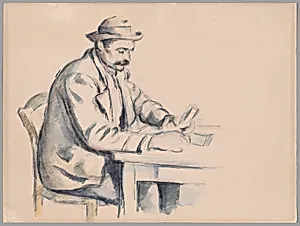
A Study for the Card Players
1890–92
Medium
Watercolor with graphite on beige wove paper
Dimensions
36.2 × 48.5 cm (14 5/16 × 19 1/8 in.)
Classification
watercolor
Department
Prints and Drawings
Museum
Art Institute of Chicago
Accession Number
133136
Rights
Public Domain
Art Historical Context
Paul Cézanne's *A Study for the Card* (1890–92) offers a captivating glimpse into the artist's late-career obsession with everyday Provençal life. Created during a pivotal period when Cézanne was refining his Post-Impressionist vision, preparatory work draws from his renowned series of oil paintings depicting humble peasants engrossed in a card game. These compositions, painted in the artist's native Aix-en-Provence, capture the dignity and timelessness of rural French existence, stripping away narrative drama to emphasize form, color, and spatial relationships. Rendered in watercolor with graphite on beige wove paper (36.2 × 48.5 cm), the piece showcases Cézanne's masterful command of translucent washes and subtle line work. Watercolor's fluidity allowed him to experiment with light, shadow, and volume, building layered hues that prefigure the structured geometry of his final oils. Housed in the Art Institute of Chicago's Prints and Drawings department, this study reveals the meticulous process behind Cézanne's innovations—techniques that profoundly influenced modern masters like Picasso and Braque. As a window into Cézanne's method, it underscores his role as a bridge between Impressionism and Cubism, inviting viewers to appreciate the quiet poetry in ordinary moments.
About the Artist
Paul Cezanne · 1839–1906
Paul Cézanne (1839–1906), born in Aix-en-Provence to a prosperous banker father, Louis-Auguste, and mother Anne-Elisabeth-Honorine Aubert, grew up in a bourgeois family that later acquired the Jas de Bouffan estate, where he painted his earliest murals. As a youth, he formed the inseparable trio "Les Trois Inséparables" with schoolmates Émile Zola and Baptistin Baille. Despite his father's wishes ...